Reader question
How do I turn conference attendee lists into booked meetings?
Events do not create pipeline by themselves. They create a narrow window of relevance that only matters if research, outreach, and follow-up happen immediately.
Event Leads Are Not Leads Until the Follow-Up Happens
Events create warm context, but most teams waste it by following up too late, too generically, or not at all.
Scroll horizontally to inspect the diagram.
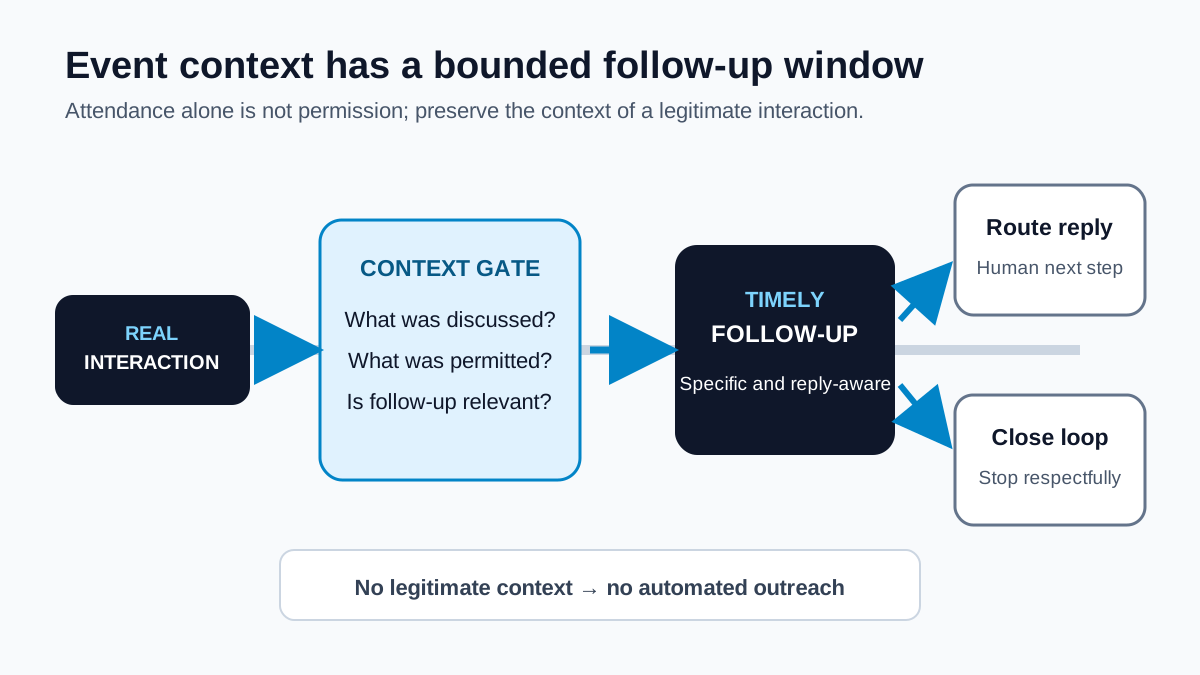
An event badge is not pipeline. Neither is a sponsor directory, webinar registration, meetup page, or exported attendee list. Events create possible context, but only an honest interaction and an appropriate follow-up route can turn that context into a sales conversation. Automating the wrong premise only makes the mistake arrive faster.
The operational challenge is narrower than “turn every attendee into a meeting.” A lean team needs to preserve what actually happened, distinguish public event information from permission, prioritize the few accounts with relevant context, complete promised follow-ups, and stop when there is no legitimate next step.
Short answer
You cannot reliably turn a conference attendee list into booked meetings. Attendee-list membership is not permission to contact someone, proof that they attended, or evidence of purchase intent. Instead, record legitimate conversations and requests, verify relevant public event context, apply your organization’s legal and channel rules, and use a bounded, reply-aware follow-up workflow. Meetings are a possible outcome, not a guarantee.
Public event context is not consent
Public event context can include an official speaker page, sponsor announcement, published agenda, or a company’s own post about attending. It may help a researcher understand the account. Consent or another applicable basis for direct marketing is a separate question about whether and how the team may use personal information and send a message.
The UK Information Commissioner’s Office direct marketing guidance tells organizations to plan for privacy, collect information fairly, choose a valid basis, and respect people’s preferences, including their right to object. Requirements vary by place, audience, and channel, so teams should get appropriate advice for their situation. A public name on a webpage does not erase those responsibilities.
Keep four event states distinct:
- Public context: the company sponsored, the person was listed as a speaker, or the agenda covered a relevant topic.
- Observed interaction: a team member actually spoke with the person and recorded what was discussed.
- Permission or request: the person asked for a resource, agreed to a follow-up, or provided channel-specific permission where required.
- Seller inference: the team believes the event context may connect to a problem it solves. This remains a hypothesis.
A permission-aware event workflow
- Define the event thesis. Before collecting names, write which accounts, roles, and topics are relevant. Also define exclusions. This keeps an event from becoming a pretext for contacting everyone nearby.
- Use attributable sources. Record the official event or company URL, what it establishes, and when it was checked. Do not assume local, side-event, or attendee coverage is complete.
- Capture real interactions immediately. Write who spoke, the actual topic, any question or request, the preferred channel if stated, and who owns the next step. Separate the person’s words from the seller’s interpretation.
- Classify the route. Place records into requested follow-up, legitimate conversation for review, public-context research, monitor, or exclude. Do not promote a public-context record into a conversation record.
- Complete the promise first. If someone requested a document, introduction, or meeting time, send that exact thing through an appropriate channel. Avoid surrounding the promised item with a generic pitch.
- Coordinate replies and stopping. Pause other planned touches when someone responds, objects, opts out, or a human takes ownership. Silence does not justify escalation across channels.
- Close the CRM loop. Record the real outcome—resource sent, meeting scheduled, monitor, disqualified, no further contact—and preserve the event provenance and preferences.
An explicitly illustrative example
Imagine a fictional founder at a security conference. She speaks with an engineering leader who asks for a short architecture note and offers a work email. The founder records the request, topic, channel, and promise. The next morning, a draft references the actual conversation and contains the requested note. That is a coherent follow-up.
The same event page also lists another executive as a speaker, but nobody on the team met him and he gave no permission. The page is useful account research. It does not support “great meeting you yesterday,” and it does not automatically make WhatsApp or email appropriate. The team may retain the public account context according to its policies, research further, or do nothing. It must not fabricate an encounter.
Speed never excuses deception
Timely follow-up is useful because people can more easily place a real interaction while the details are current. It is not a license to rush past verification. Do not claim someone visited your booth, attended a session, or discussed a topic unless your evidence establishes it. LinkedIn’s Professional Community Policies require authentic identity and reject false, misleading, spammy, untargeted, or obviously unwanted promotional activity.
For U.S. commercial email, the FTC’s CAN-SPAM compliance guide includes truthful header and subject information, identification and address requirements, and an honored opt-out. Other laws and platform rules may be stricter or require consent. Attendee-list membership is not permission, and this article is not legal advice.
Common mistakes
- Buying or importing a list without understanding how the information was collected or may be used.
- Calling every registrant an attendee, every attendee a lead, or every booth scan a conversation.
- Using “we met” language when the evidence only shows a public event association.
- Contacting a person on WhatsApp without the required opt-in or after they asked to stop.
- Continuing a generic sequence after a reply, handoff, disqualification, or opt-out.
- Measuring event success only by messages sent instead of promises completed and truthful outcomes recorded.
How Gwenth applies this
Gwenth can help organize available event, signal, and account context, prioritize records for review, carry verified context into email or LinkedIn drafts, and support WhatsApp workflow context only where the required permission and configured route exist. Coverage depends on connected sources and user configuration; Gwenth does not guarantee access to attendee lists, local-event discovery, or complete event data.
Unified inbox and reply handling can keep the original interaction beside a response, while meeting context, CRM/account records, and next-action support can preserve promises and outcomes. A person still decides whether the evidence is truthful, the route is appropriate, and the follow-up should happen. Gwenth does not guarantee consent, deliverability, meetings, conversions, or autonomous results.
Read next: use the detailed B2B event lead follow-up playbook, and see why the workflow belongs in an AI sales execution platform rather than a disconnected spreadsheet.
Tags
References
Source material used for factual context in this article.
- Direct Marketing Guidance
Information Commissioner’s Office · Accessed
Supports the distinction between obtaining event data and having an appropriate lawful, preference-aware basis for direct marketing.
- CAN-SPAM Act: A Compliance Guide for Business
Federal Trade Commission · Accessed
Supports the U.S. commercial-email requirements discussed here, including truthful routing and subjects, identification, and honored opt-outs.
- LinkedIn Professional Community Policies
LinkedIn · Accessed
Supports the article’s rejection of false identity, misleading event context, spam, and untargeted or obviously unwanted promotional messages.