Reader question
How do I find B2B accounts that are ready to buy now?
Static lead lists are a lazy substitute for timing. The strongest outbound starts with buying-window evidence: the account is changing, and that change creates a reason to talk now.
Stop Buying Lead Lists. Start Watching Buying Windows.
Firmographics tell you who could buy. Buying-window intelligence tells you who is changing right now, and why now is the only timing that matters.
Scroll horizontally to inspect the diagram.
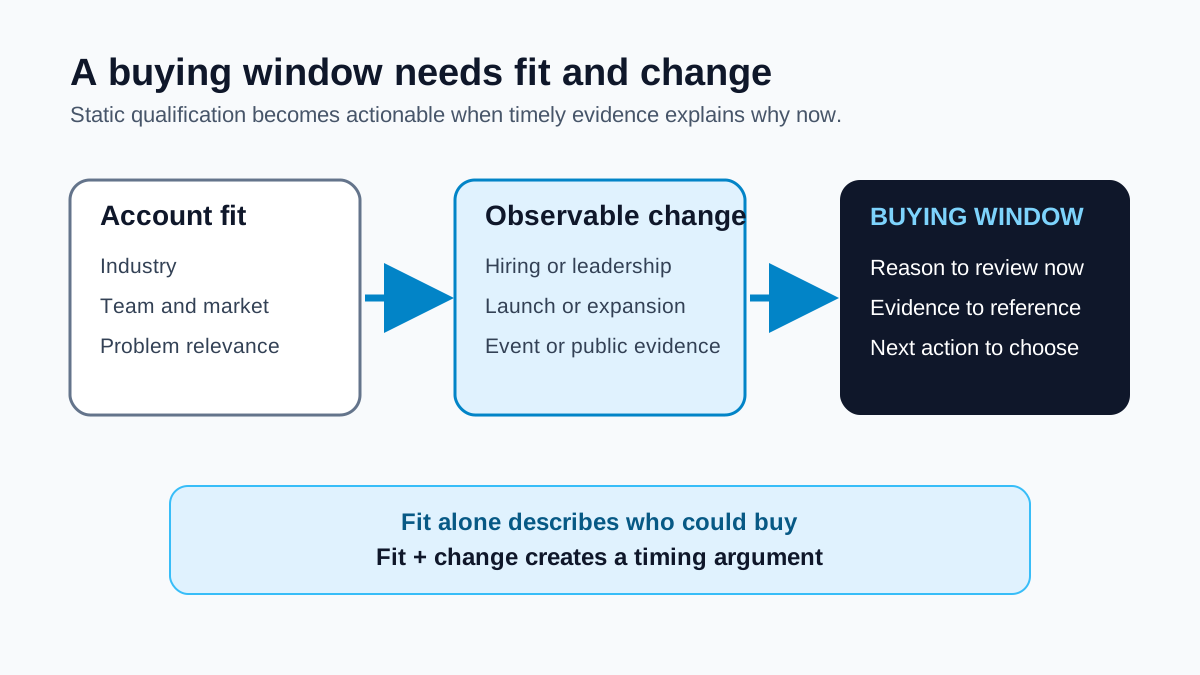
Lead lists are a comfort blanket. They make a team feel productive while hiding the hardest prospecting question: why is this account worth careful attention now? A list can identify thousands of companies that resemble your customers. It cannot, by itself, explain what changed, whether the evidence is current, or whether there is an appropriate next action.
Firmographics are still useful. Industry, operating model, size, geography, and known technology can describe fit. The mistake is treating fit as timing. Buying-window intelligence adds observable change and a reasoned connection to the problem you solve. It narrows a broad market into a review queue; it does not reveal private intent or guarantee that anyone is buying.
Short answer
You cannot know from public signals alone which B2B accounts are “ready to buy.” You can identify accounts that deserve review by monitoring attributable changes such as hiring, filings, product launches, expansion announcements, leadership changes, or legitimate event conversations. Rank the observation by account fit, recency, evidence quality, relevance, and actionability, then have a person verify it before outreach.
Fit, signal, and buying window are not synonyms
Fit describes whether an account could plausibly benefit from your product. A signal is an observation from a source: a job post, filing, announcement, or conversation. A buying window is your team’s time-bounded hypothesis that one or more verified signals make a specific problem newly relevant. The window is an interpretation, not a fact reported by the buyer.
That distinction prevents a familiar failure. A team sees a company hiring and leaps to “they need our software.” Hiring may reflect replacement, normal turnover, a talent pipeline, or a plan unrelated to your offer. The U.S. Bureau of Labor Statistics’ JOLTS program reports aggregate openings, hires, and separations, which is valuable market context. It does not identify an individual account’s project or purchasing plan.
A six-step buying-window workflow
- Write the market hypothesis first. Name the account profile, operational problem, buyer role, and observable changes that might make the problem more urgent. If the team cannot explain the connection before collecting data, more signals will only create more noise.
- Collect inspectable observations. Save the source URL, observation date, and what the source actually says. For public companies, the SEC’s Search Filings provides access to company disclosures. A filing can establish that a disclosed change occurred; it still needs careful interpretation.
- Separate fact from inference. “The company posted three implementation roles” is observable. “The company is replacing its CRM” is an inference unless a source or conversation supports it. Store both, but label them differently.
- Score for review, not prediction. Use a small set of understandable dimensions: fit, recency, evidence quality, problem relevance, and whether a responsible next action exists. A high score should move an account up a queue, not authorize contact automatically.
- Verify before acting. Check whether the observation is current, duplicated, contradicted, or already known in the account record. Review contact preferences and channel constraints. If the hypothesis remains weak, research or monitor instead of sending.
- Record the outcome. Capture whether the signal led to research, outreach, a reply, disqualification, or no action. Feedback is how a team learns which observations are useful in its actual market.
An explicitly illustrative example
Consider a fictional cybersecurity vendor serving regional financial firms. Its target account publishes a new security engineering role and an attributable expansion announcement. Those two observations are current and relevant to the vendor’s market, but neither proves a security project or budget.
The team checks the account record and finds no existing relationship or exclusion. It reads the role details and sees that identity governance is part of the remit. The account now deserves human review because the evidence is specific enough to support a question. A measured note might acknowledge the public role and ask whether scaling access reviews is part of the new remit. It should not say, “We know you are replacing your identity system.” If the role is a routine backfill or the account already said no, the team should lower the priority or disqualify it.
Common mistakes make signals look smarter than they are
- Counting copies as corroboration. Five articles repeating one press release are one underlying observation, not five independent signals.
- Treating age as urgency. A new page is not automatically relevant, and an old source can remain useful if it describes a continuing program. Recency must be interpreted.
- Inferring people from companies. A company-level change does not establish what a particular contact knows, wants, or controls.
- Hiding uncertainty in a score. Keep the source and the reasoning visible. A precise-looking number does not improve weak evidence.
- Using public context as permission. Public information can inform research. It does not grant consent or override applicable marketing rules, platform policies, or a person’s preferences.
How Gwenth applies this
Gwenth can bring available signal and account context into a prioritization workflow, depending on the sources the team connects and configures. The useful unit is the observation with provenance: what changed, where it came from, when it was seen, and why the team thinks it matters. That context can support a review queue instead of a raw contact list.
For an account the team chooses to pursue, the same reasoning can inform an email or LinkedIn draft, meeting context, CRM/account records, and next-action support. Replies and disqualifications should update the relationship state rather than disappear in another tool. Gwenth does not guarantee intent, source coverage, deliverability, or conversion. It helps a team preserve the evidence and judgment behind its next move.
Read next: apply the practical buying-signal scoring framework, then see how this fits into the broader AI sales execution platform category.
Tags
References
Source material used for factual context in this article.
- Job Openings and Labor Turnover Survey
U.S. Bureau of Labor Statistics · Accessed
Supports the distinction between broad labor-market context and account-level evidence; JOLTS reports aggregate openings, hires, and separations.
- Search Filings
U.S. Securities and Exchange Commission · Accessed
Supports using attributable public-company disclosures as research evidence while requiring interpretation before any outreach conclusion.