Reader question
How should B2B teams follow up with event leads after a conference?
Thoughtful event follow-up starts by preserving the context of legitimate conversations and permissions, then gives sellers a bounded, reply-aware path from timely follow-up to a complete CRM record.
The B2B Event Lead Follow-Up Playbook
A useful event follow-up process preserves the context of real conversations, respects permission and preferences, and closes the CRM loop when no appropriate next step remains.
Scroll horizontally to inspect the diagram.
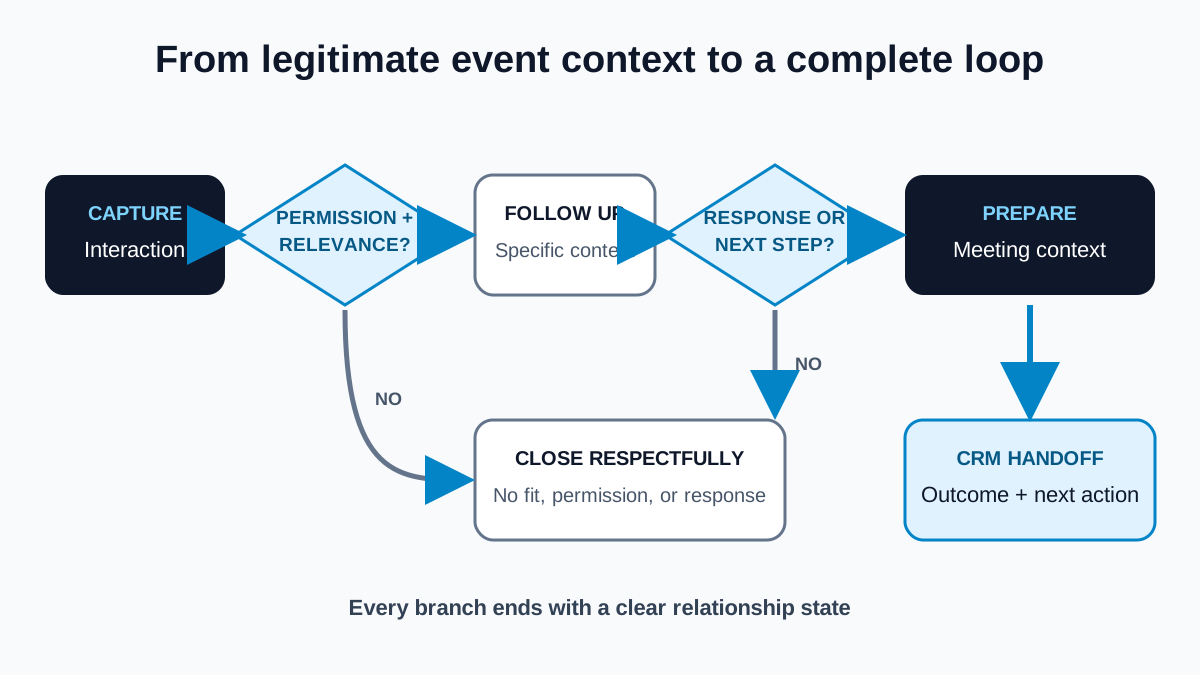
The value of an event is not the badge scan or the attendee spreadsheet. It is the context a team earns through real conversations: what someone asked, what they were trying to solve, who they introduced, and what they invited you to do next. That context evaporates quickly unless it is captured, reviewed, and handled with care.
Short answer
B2B teams should follow up after a conference by immediately recording legitimate conversations, stated interests, permissions, and next steps; then use a short, reply-aware cadence for people with an appropriate reason to hear from the team. Route replies to a human, stop when there is no fit or permission, and close the CRM record with the actual outcome. Attendee-list membership is not permission to contact someone.
This is Gwenth editorial guidance, not legal advice and not a promise about conversion, deliverability, consent, or product results. Teams remain responsible for their own policies, applicable requirements, data sources, and contact preferences. The UK Information Commissioner's Office advises organizations to plan direct marketing responsibly and respect people's preferences. The U.S. Federal Trade Commission's CAN-SPAM compliance guide explains requirements for commercial email, including truthful message information and an opt-out route. Requirements vary by jurisdiction and channel, so teams should obtain appropriate advice for their circumstances. Do not use deceptive outreach, imply a relationship that did not happen, or fabricate event context to get attention.
Phase 1: capture context immediately
Before the team leaves the venue—or as soon as a conversation ends—capture the smallest set of facts that will make the follow-up honest and useful. A generic note such as “met at booth” is rarely enough. Write what actually happened, without inflating it: the person's role, the topic they raised, the relevant account context, any resource requested, any follow-up invitation, and the preferred channel if they stated one.
- Who spoke with whom and where the conversation occurred.
- The buyer's words or question, separated from the seller's interpretation.
- Any requested resource, meeting, introduction, or agreed next step.
- Permission signals, contact preferences, or an explicit request not to follow up.
- Open questions that need research before a useful response is possible.
Scan data can help an operations team reconcile records, but it is not a substitute for this context. Attendee-list membership is not permission, and a badge scan alone does not create a real conversation. A responsible workflow distinguishes legitimate permission or a real conversation from mere list membership. When the record is unclear, do not stretch it into an outreach reason; mark it for review or leave it alone.
Before sending: establish the right route
Sort the captured records into a small number of states. First, people who asked for something or agreed to a next step. Second, people who had a substantive conversation where a relevant, welcome follow-up is appropriate under the team's policies. Third, people who need research before any decision. Fourth, people who should be excluded because there was no meaningful context, the record is uncertain, or they indicated a preference not to be contacted.
That classification prevents a common event mistake: treating every name near the event as equally warm. It also keeps the team from sending a generic “great meeting you” message to someone they never met. Event follow-up automation is only useful when it carries accurate context and gives people a clear path out of the workflow.
Days 1–3: deliver the promised next step
The first window is for continuity. If someone requested a deck, a case study, an introduction, or a meeting time, send the exact thing that was discussed while the context is fresh. Name the event only if it is true, mention the specific topic only if it was actually discussed, and keep the message short enough that the promised action is unmistakable.
For a person with a legitimate conversation but no explicit request, the appropriate first note can acknowledge the topic and offer a low-pressure next step: a relevant resource, a chance to continue the discussion, or a question that helps them correct your understanding. Do not pretend that a brief greeting was a buying conversation. If there is no clear context or no appropriate permission route, do not send a follow-up merely because the event happened.
Days 4–7: add useful context, not pressure
Use the second window to follow through on an open question or share one genuinely relevant piece of context. That could be a concise answer to a topic raised at the event, a resource the person asked for, or a clarification after internal research. The purpose is to make the original exchange easier to continue, not to manufacture urgency.
Keep the record synchronized across channels. If a buyer replied by email, do not continue a parallel message somewhere else as though nothing happened. If a colleague took the conversation, route the context to that person rather than restarting from a template. Multi-channel outreach with shared context is a coordination problem, not a license to multiply unsolicited touches.
Days 8–14: make a clear choice
By the third window, the team should either have a specific next step, a reason to monitor the account, or a reason to close the event-follow-up motion. Where an appropriate follow-up is still open, a brief close-the-loop note can make the decision easy: restate the relevant resource or question, offer one concrete path to continue, and respect a lack of engagement or a request not to proceed.
Do not extend the sequence because a dashboard prefers more activity. A non-response is not a prompt to become more persistent across channels. It is a signal to stop, reassess, or use a future, independently appropriate reason only if your team's policies allow it. Bounded follow-up protects the accuracy of the event context and the time of both people.
Reply handling: people take over
A reply changes the job. Pause automated follow-up, assign a human owner, and attach the original event notes before anyone responds. The owner should answer the question asked, correct any mistaken assumption, and decide whether a meeting, resource, introduction, or no further action is appropriate. If the buyer says no, asks not to be contacted, or reveals a poor fit, record that clearly and honor it.
For meetings that do happen, carry the event history into the preparation. The seller should know what brought the conversation forward, what was promised, and what questions remain—not merely that the contact came from an event. Meeting preparation from sales intelligence turns that relationship memory into a more coherent next conversation.
CRM closure: document the truth, not activity
When the event motion ends, close the loop in the CRM. Record the source as precisely as the evidence allows, preserve the conversation notes and permissions, identify the owner, and set the outcome: meeting scheduled, resource delivered, active follow-up, monitor, disqualified, or no further contact. Avoid a vague “contacted” status that hides what actually happened.
Closure matters because it prevents the same person from being re-enrolled under a different list without context. It also lets the team learn which event conversations were useful without converting activity into invented results. The AI sales execution platform perspective is simple: the system should preserve relationship memory from a real interaction through the next action and the CRM record.
Reusable event follow-up checklist
- Capture what was actually said, any requested follow-up, and stated preferences.
- Separate explicit next steps and real conversations from uncertain scans or attendee-list records.
- Verify the account context before sending anything that refers to it.
- During days 1–3, deliver the agreed resource or next step accurately.
- During days 4–7, add only useful, relevant context and coordinate replies across channels.
- During days 8–14, choose a concrete next step, monitor state, or closure; do not prolong activity for its own sake.
- Pause automation on replies, route to a human, and honor opt-outs or no-contact preferences.
- Close the CRM record with the source, evidence, owner, and real outcome.
The standard is continuity, not volume
A considerate event playbook makes it easier for a buyer to recognize why a follow-up arrived and easier for a seller to do what they promised. It does not turn attendance into consent or activity into demand. Preserve the context, limit the motion to what is appropriate, and let the CRM reflect the outcome. That is how an event becomes a useful part of an ongoing sales workflow rather than an excuse for a bulk list.
How Gwenth applies this
Gwenth can organize available event, account, signal, and relationship context, support a human review queue, and carry verified details into email or LinkedIn workflow drafts, unified reply handling, meeting context, next-action support, and CRM/account records. WhatsApp workflow context depends on a configured route and appropriate permission. Coverage depends on connected sources and user configuration; Gwenth does not guarantee attendee access, event-data completeness, local-event discovery, permission, consent, deliverability, meetings, or product outcomes. Users remain responsible for verifying context, approving messages, honoring preferences, and stopping an inappropriate workflow.
Read next: see why event follow-up needs context-aware automation, then use that context to prepare the next real conversation.
Tags
References
Source material used for factual context in this article.
- Direct marketing guidance
UK Information Commissioner's Office · Accessed
Provides official guidance on planning direct marketing responsibly, collecting information fairly, and respecting objections and opt-outs.
- CAN-SPAM Act: A Compliance Guide for Business
U.S. Federal Trade Commission · Accessed
Provides official U.S. guidance on truthful commercial email, accurate headers and subjects, identification, and opt-out handling.