Reader question
What is the difference between an AI SDR and an AI sales execution platform?
An AI SDR that only automates email is too narrow. Buyers need one execution layer that finds timing, starts conversations, adapts to replies, preps meetings, and updates the CRM.
The AI SDR Category Is Too Small
AI SDR tools that only write emails are point products. The real category is an AI sales execution platform that carries context from signal to reply to meeting to CRM follow-up.
Scroll horizontally to inspect the diagram.
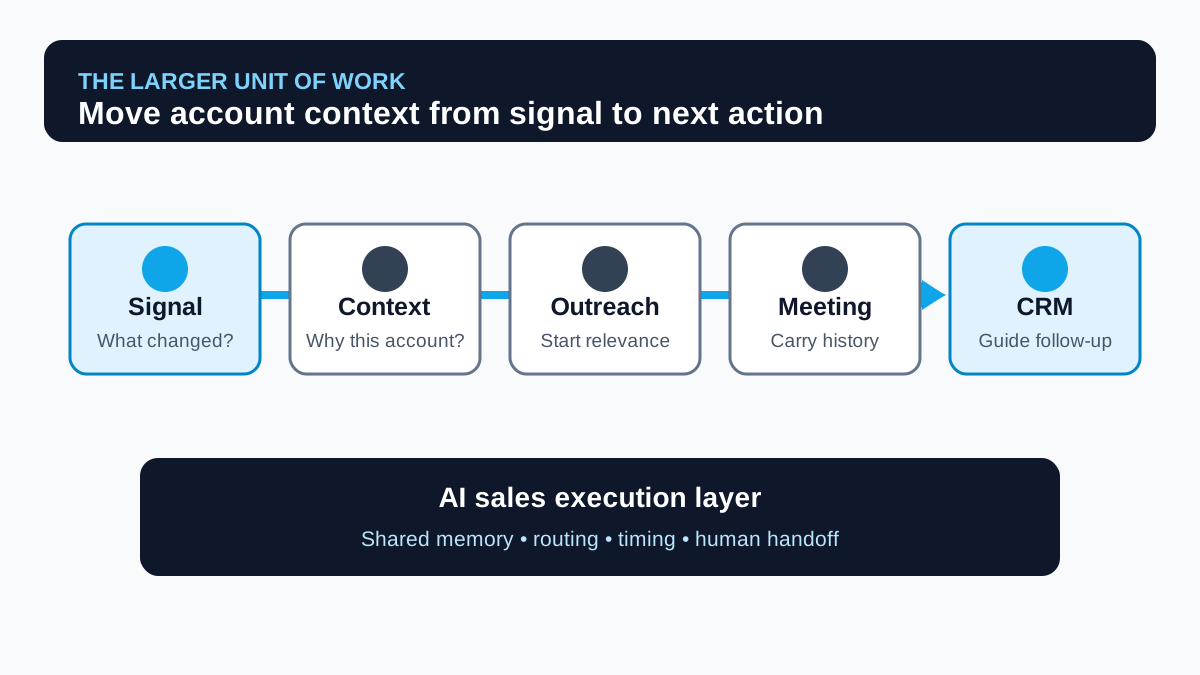
The AI SDR category is too small. Most tools in it are judged by one visible output: did the system produce and send a plausible prospecting message? That is useful, but it is not the whole sales job. A message can be well written and still target the wrong account, arrive for no defensible reason, ignore a reply on another channel, or leave the founder reconstructing the conversation in the CRM.
Founders and lean B2B software teams feel those gaps immediately because there is no operations department waiting to stitch the workflow together. They do not need another writer beside a lead database. They need an AI sales execution platform that carries accountable context from an observed account change through prioritization, outreach, reply handling, meeting preparation, CRM memory, and the next action.
Short answer
An AI SDR automates parts of outbound sales, commonly prospecting drafts, sequences, and follow-ups. An AI sales execution platform coordinates the larger workflow: account and signal context, prioritization, channel-aware outreach, unified reply handling, meeting context, CRM records, and next-action support. The difference is not “more AI.” It is whether evidence and relationship state survive from one step to the next.
AI SDR and sales execution are different scopes
“SDR” describes a role boundary. “Sales execution” describes a workflow boundary. An AI SDR product can be effective inside its lane and still leave the team with five manual handoffs. The broader category starts by treating those handoffs as the product problem.
The unit of work is not “send an email.” It is “help the team choose and complete the next responsible action for this account without losing why the account mattered.” That requires generation, but also provenance, memory, routing, review, and stopping rules. The NIST AI Risk Management Framework is useful here because it frames AI as a system operating in a context, with accountability and risk management across its lifecycle—not as a magic output box.
A practical five-part execution framework
- Observe a change. Start with inspectable account evidence: a role posted, a public filing, a product launch, an event conversation, or another connected-source observation. Record the source and date separately from the interpretation. A signal is a reason to research, not proof of intent.
- Decide whether it deserves attention. Combine fit, recency, evidence quality, relevance, and actionability. A promising observation may still belong in monitoring if the account is a poor fit, the source is weak, or there is no appropriate contact route.
- Choose a relationship action. Decide whether to research further, draft an email, prepare a LinkedIn touch, use an already-permitted WhatsApp route, or do nothing. Channel availability, platform policies, contact preferences, and local requirements are constraints, not optimization variables.
- React to what happens. A reply should change the state of the relationship. Pause conflicting follow-ups, bring the conversation into a shared inbox or record, and give a person enough context to respond to the actual question.
- Preserve the outcome. Put the useful facts, promises, meeting context, owner, and next action into the account record. The point is not to log more activity. It is to make the next interaction coherent.
An illustrative execution loop
Imagine a fictional payroll software founder whose target account publishes several implementation roles across two new markets. The system records the job pages and dates, but it does not label the company “ready to buy.” The founder reviews the evidence, confirms the account fits, and approves a concise email about the operational complexity of multi-country implementation.
The buyer replies that the timing is early but asks for a comparison guide. That reply should stop the planned channel touches, appear with the original hiring context, and create a clear human next action: send the requested guide and ask whether a later planning conversation would be useful. If a meeting follows, its brief should include the observed expansion, the exact reply, and the promise already made. Afterward, the CRM record should reflect the real outcome rather than a guessed deal stage. None of those steps guarantees a meeting or conversion. Together they prevent the workflow from forgetting itself.
Where the bigger category can still go wrong
Connecting more steps increases responsibility. A weak signal can become a confident narrative. A draft can imply that a person attended an event when only the company was listed as a sponsor. An old reply can be overwritten by a fresh sequence. An automatically proposed CRM update can be wrong. Human review and visible source context matter most where the system is uncertain or the action affects another person.
Teams should also distrust claims that an agent “runs sales autonomously” without explaining sources, controls, failure modes, and human ownership. The FTC’s enforcement announcement about deceptive AI claims describes action against unsupported claims that an AI service could substitute for professional work. An execution platform should reduce coordination work, not create a fiction that judgment, compliance, or buyer choice disappeared.
- Do not mistake a score for verified purchase intent.
- Do not let one channel continue after another receives a meaningful reply or opt-out.
- Do not write account facts into the CRM without source context or review where needed.
- Do not optimize for volume before the team can explain its selection and stopping rules.
How Gwenth applies this
Gwenth is designed around the context chain rather than a single generated message. Depending on the sources a team connects and the workflow it configures, account and signal context can support prioritization, drafts for email or LinkedIn, and appropriate WhatsApp workflow context where the recipient has given the required permission. Replies can be handled with shared relationship context instead of isolated campaign history.
When a conversation advances, Gwenth can carry relevant account, reply, and meeting context into preparation, CRM/account records, and next-action support. People remain responsible for verifying evidence, approving sensitive actions, honoring channel rules and preferences, and correcting the record. Gwenth does not guarantee intent, deliverability, consent, meetings, or autonomous outcomes; it helps a lean team execute a chosen motion with less context loss.
Read next: learn why teams should stop buying lead lists and start watching buying windows, then use the buying-signal scoring framework to make prioritization inspectable.
Tags
References
Source material used for factual context in this article.
- Artificial Intelligence Risk Management Framework (AI RMF 1.0)
National Institute of Standards and Technology · Accessed
Supports the article’s emphasis on context, accountability, transparency, and human oversight when AI assists consequential workflows.
- FTC Announces Crackdown on Deceptive AI Claims and Schemes
Federal Trade Commission · Accessed
Supports the warning against unsupported AI capability claims, including claims that an AI service can replace professional work without evidence.