Reader question
How should a lean B2B team build an AI sales automation workflow?
A lean B2B team should build AI sales automation as a small observable system: a verified trigger creates a reviewable proposal, a named person owns action, replies and preferences change routing, and outcomes improve the next queue.
AI Sales Automation Workflow: From Signal to Follow-Up (2026)
A framework for a lean B2B team to automate repeated sales operations while reserving evidence interpretation and buyer decisions for people.
Scroll horizontally to inspect the diagram.
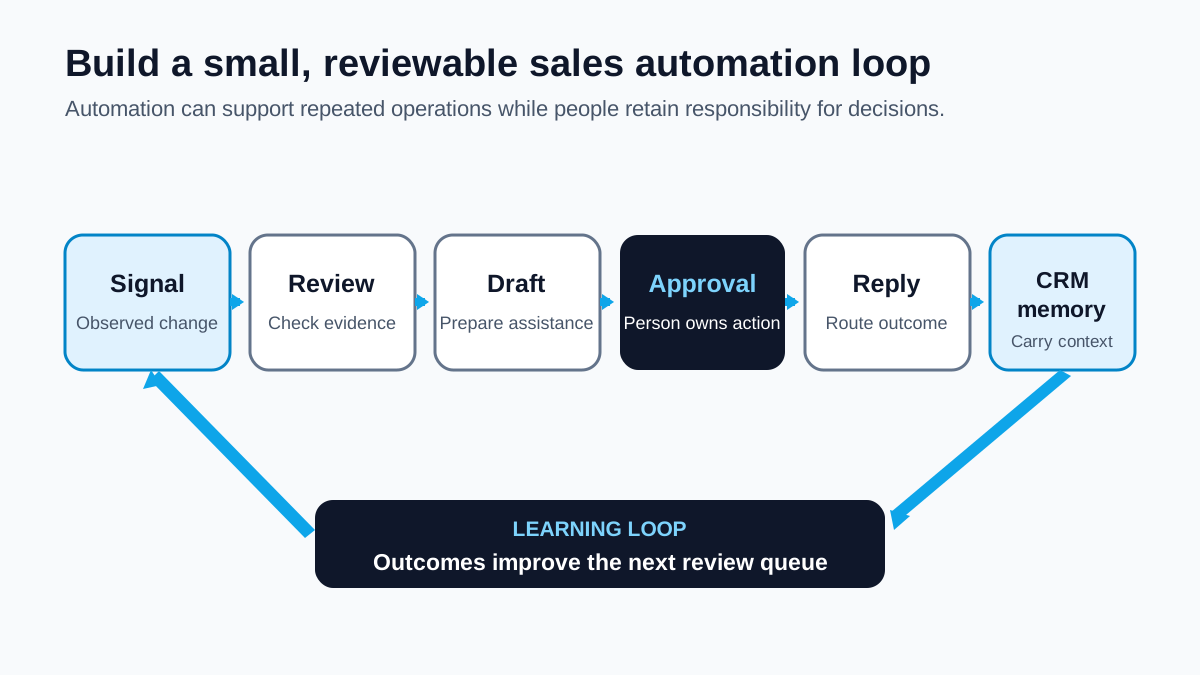
A lean team should automate repeated operations, not automate away commercial judgment. The useful unit is a workflow with an observable trigger, a bounded proposal, a person who owns the decision, and a record of what happened. This makes improvement possible because the team can see where evidence, interpretation, action, and outcome diverged.
Short answer
Build a small loop: capture a verifiable trigger, normalize it to the right account, let a person review relevance, generate only allowed assistance, route replies and preferences into the record, and measure quality before expanding. The NIST AI RMF provides governance/oversight framing: define context, roles, risks, measurement, and human oversight. The goal is responsible execution, not an autonomous outcome claim.
Workflow diagram
Observed source → normalized account event → human review queue → approved research or draft → controlled channel action → reply/preference route → CRM and next-action memory → weekly quality review.
Each arrow needs enough context for the next person to understand why it exists. The source is not the interpretation; the interpretation is not permission; a draft is not an approved message; and an activity log is not buyer value. Separate those states so automation cannot make accidental promises.
Trigger-to-action table
| Trigger | Automated assistance | Human decision | Stop or redirect |
|---|---|---|---|
| Public account change | Attach source, date, account match, research prompt | Is it relevant and accurate enough to investigate? | Weak source, poor fit, stale event, uncertain identity |
| Approved account | Prepare draft from verified context | Is claim accurate and route appropriate? | Missing permission or no responsible contact |
| Meaningful reply | Pause conflicting tasks and present history | How should we respond? | Opt-out, objection, no-contact request |
Pilot scope
Start with one vertical, one segment, one source type, and one approved channel. Limit the pilot to a reviewable number of accounts. Write the boundary plainly: record public changes with a URL and date; a founder reviews relevance; drafts require approval; any reply pauses planned touches and creates a human-owned task.
For email, build policy checks into the route rather than treating them as an afterthought. The Federal Trade Commission’s CAN-SPAM compliance guide describes requirements including accurate routing information, a clear opt-out mechanism, and prompt honoring of opt-out requests for commercial email. The workflow should preserve those stop events, never continue an email sequence after an opt-out, and require human review of customer-facing claims. LinkedIn activity should likewise stay within applicable platform rules and a team’s approved, non-deceptive process.
Decision rights
Name an owner for source acceptance, account fit, contact selection, message approval, CRM changes, and suppression overrides. In a two-person team one person can hold several roles, but the decision should remain visible. No model should be final authority on a factual claim, buyer intent, compliance interpretation, or irreversible commercial change.
Measurement
Measure source acceptance, correction reasons, whether replies pause planned activity, unresolved tasks, and next-action ownership. These are quality indicators, not guarantees. Weekly, sample accepted and rejected records: can a teammate reconstruct the source, interpretation, approver, and next action?
Failure modes
- False precision: a score looks like proof though evidence is stale.
- Broken identity: enrichment attaches an observation to the wrong account.
- Channel conflict: a sequence continues after a reply elsewhere.
- Summary drift: a CRM update removes uncertainty.
- Approval theater: the queue is too large for real review.
30-day rollout
- Days 1–7: map motion, source, record, owners, and stop conditions.
- Days 8–14: run source-to-review with no automatic sending.
- Days 15–21: add approved draft assistance and reply-aware routing.
- Days 22–30: review failures, refine rules, and decide whether expansion is justified.
The AI sales execution platform model keeps evidence, review, communication, replies, and CRM memory as connected responsibilities rather than disconnected automations.
Evidence packet design
A trigger should produce a compact packet, not a conclusion: original URL or source, observation date, matched account, uncertainty, and the question for a reviewer. For example, “A public role change was observed; is it relevant to this account and worth research?” is a usable queue item. “They are ready to buy” is an unsupported leap that makes later correction harder.
Give the reviewer more than approve or reject. They need to research, revise, defer, disqualify, suppress, and record why. That decision note is part of the system’s memory: it prevents the same weak signal from reappearing as a fresh recommendation and makes the next quality review concrete.
Approval is a specific decision
Keep source acceptance, account fit, contact selection, factual claims, message approval, and CRM updates distinguishable even if one founder owns several of them. The name of the approver, the source they saw, and the scope of the approved action should remain visible. A draft is preparation; it is not permission to communicate.
When a reply, objection, preference, identity problem, or material correction arrives, pause conflicting activity before another touch is proposed. Route the context to a person who can decide the next step. That makes the workflow useful for ongoing relationships rather than a one-way production line.
Quality review uses counterexamples
Each week, sample a few accepted items, rejected items, and stop events. Check whether the source was retrievable, the account match was correct, the approved action matched the evidence, and the CRM reflects what actually happened. Include counterexamples deliberately: a stale event, a wrong entity match, an unsupported claim, and an account that should be held.
Use those findings to tighten source rules, ownership, and templates before adding another segment or channel. Counts of drafts or activity can reveal workload, but they do not show buyer value. A workflow is improving when a teammate can reconstruct a decision, correct an error, and see who owns the next action.
Limits that matter in operation
Automation can coordinate repeatable steps; it cannot establish intent, contact permission, factual accuracy, deliverability, a meeting, or a commercial outcome. Connected data can be incomplete or wrongly matched, and a model can summarize with more confidence than its source warrants. Preserve provenance, use small pilots, and retain human review where an error changes communication or a durable commercial record.
Make the system of record explicit
Choose one durable location for the current account state and define what each connected tool may write there. A useful record includes the observed source, decision date, reviewer, active owner, next action, and stop conditions. Do not overwrite a customer reply with an optimistic summary; preserve the original interaction and attach the interpretation separately so a teammate can correct it later.
Escalate uncertainty instead of hiding it
Set simple escalation rules: uncertain identity goes to research, an unsupported claim returns to drafting, an opt-out or no-contact request goes to suppression, and a consequential record change needs an accountable owner. These rules make the workflow slower only at the moments where confident automation could create the most expensive mistake. Everything else can remain deliberately lightweight.
Review the escalation log during the weekly quality meeting. Repeated uncertainty is a signal to improve source rules, templates, or ownership—not a reason to silently lower the standard for an external action.
How Gwenth applies this
Depending on sources and configuration, Gwenth can organize account and signal context, support review queues, prepare drafts for approved workflows, preserve reply-aware context, and carry useful outcomes toward CRM records. Users remain responsible for validation, approvals, compliance, record accuracy, and buyer decisions.
Read next: pair the rollout with founder-led sales automation and CRM relationship memory.
Tags
References
Source material used for factual context in this article.
- Artificial Intelligence Risk Management Framework (AI RMF 1.0)
NIST AI RMF · Accessed
Supports governance/oversight framing: AI workflows need context, documented roles, measurement, and human oversight rather than autonomy claims.
- CAN-SPAM Act: A Compliance Guide for Business
Federal Trade Commission · Accessed
Supports the email-policy boundary: commercial email needs accurate routing information, a clear opt-out mechanism, and prompt honoring of opt-out requests under the FTC’s CAN-SPAM guidance.
- Gwenth
Gwenth · Accessed
Supports Gwenth as a human-reviewed execution layer that can organize context and approved next actions for a configured team workflow.