Reader question
How can AI find sales signals for a specific vertical?
Vertical GTM will beat generic AI sales tooling because buying-window evidence is market-specific. The system must understand what movement looks like in each ICP.
Vertical GTM Will Beat Generic AI Sales Tools
Generic sales tools produce generic timing. Vertical signal intelligence wins because every market has different evidence that a buyer is moving.
Scroll horizontally to inspect the diagram.
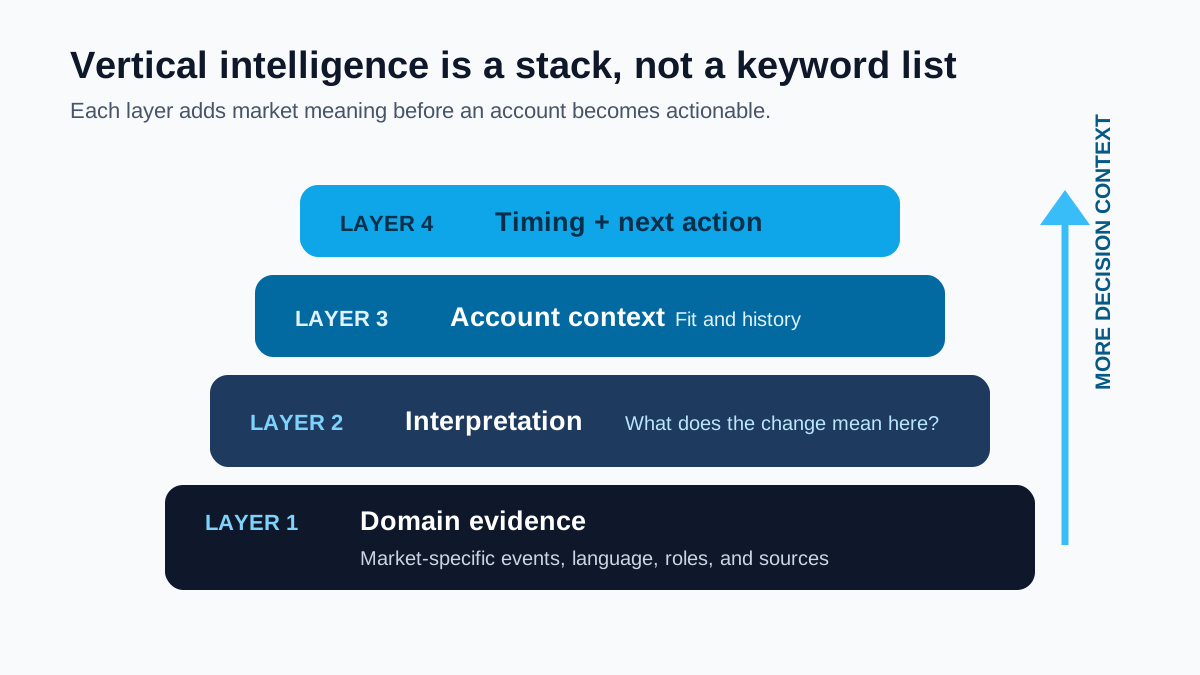
Generic AI sales tools create generic outbound. They can summarize a website, produce a plausible persona, and restate broad company news. The result often sounds fluent while missing the market mechanism: what changed, why that change matters in this vertical, which role would own the consequence, and what evidence would disprove the hypothesis.
Vertical signal intelligence is not a bigger pile of keywords. It is a market-specific method for turning observable evidence into a reviewable account hypothesis. Its advantage is precision of reasoning, not certainty. A vertical model can still be wrong, incomplete, stale, or biased by the sources it can see.
Short answer
AI can support signal discovery for a specific vertical when the team defines the market’s entities, change events, sources, buyer roles, evidence standards, and disqualifiers. The system can collect connected-source observations, rank them for review, and carry verified context into outreach and CRM workflows. It cannot infer purchase intent reliably from public data or guarantee that its source coverage is complete.
Generic enrichment and vertical intelligence are different
Generic enrichment describes an account: industry label, employee range, location, website, and perhaps technology attributes. Vertical intelligence explains how specific evidence might change the account’s operating situation. It connects a source observation to a domain mechanism and a role—while preserving uncertainty.
For an HR software team, a public cluster of payroll implementation roles across new countries may justify research into workforce operations. For a cybersecurity vendor, a newly disclosed product expansion plus security hiring may justify research into access or governance complexity. Neither observation proves a problem, project, budget, or buyer. The value lies in asking a better question than “does this company fit our size filter?”
Build a vertical signal model in seven steps
- Define the operating problem. Name the workflow your product changes, the conditions that make it difficult, and the roles who experience or own it. Avoid starting from available data because availability can distort the market thesis.
- Create an entity map. List the accounts, locations, business units, roles, technologies, regulations, events, and programs that matter. Decide which entity relationships the team can verify.
- Write signal hypotheses. Use the form: “When observable change X occurs, role Y may face problem Z because mechanism M changes.” Add the plausible alternative explanations that would make the signal weak.
- Choose attributable sources. Prefer company pages, official filings, regulator publications, public job posts, and properly recorded first-party conversations where relevant. Save source, date, jurisdiction, and observation separately from the model’s interpretation.
- Set evidence and recency rules. Define what must be true before an item reaches review, when it becomes stale, and whether two observations share one underlying source. Do not allow multiple copies of one announcement to create artificial confidence.
- Rank and review. Combine ICP fit, source quality, recency, mechanism relevance, and actionability. A person checks the evidence, account history, permissions, and exclusions before choosing research, monitoring, outreach, or disqualification.
- Learn from outcomes. Record whether the hypothesis was confirmed, corrected, irrelevant, or impossible to verify. Update the model when the same false positive or missing signal appears repeatedly.
Use public sources at the right level
Authoritative datasets are valuable, but their unit of analysis matters. The Bureau of Labor Statistics Job Openings and Labor Turnover Survey describes aggregate openings, hires, and separations. It can inform a labor-market thesis; it does not show that one named company has a purchase project. Account-specific public job pages may provide narrower evidence, but they still need verification and interpretation.
The SEC’s Search Filings gives public access to company disclosures. A filing may establish an expansion, risk, acquisition, or stated strategic priority. It does not establish that a particular buyer wants a sales message. Treat source facts, model interpretation, and outreach decision as three separate records.
Two explicitly illustrative signal hypotheses
HR software example: A fictional retailer announces entry into a new country and posts several payroll implementation roles. The observation may make multi-country onboarding or payroll coordination relevant to research. The team should verify dates, locations, and whether the roles are new or replacement hiring. It should not write “your payroll system cannot handle expansion” without evidence.
Cybersecurity example: A fictional software company discloses an enterprise product launch and adds identity engineering roles. That combination may make access-governance complexity worth investigating. The hypothesis weakens if the roles belong to the product itself rather than internal security, or if the account record shows a recent disqualification. A good model makes those failure conditions visible.
Limitations and safety
Vertical specificity can make an inference sound more authoritative than it is. NIST’s AI Risk Management Framework emphasizes mapping context, intended use, affected parties, risks, and human oversight. A sales signal model deserves the same discipline: document where it works, which sources it relies on, who reviews it, and what happens when it is wrong.
- Do not use sensitive personal data or invasive inference merely because it appears predictive.
- Do not convert regulatory pressure, an incident, or workforce change into fear-based or deceptive outreach.
- Do not assume a public signal grants permission to contact a person or use a channel.
- Do not hide missing geographic, language, company-size, or local-event coverage.
- Do not treat an account score as a universal model or proof of intent.
How Gwenth applies this
Gwenth can organize available signal and account context around a team’s chosen vertical thesis, then support prioritization and review. Depending on the sources connected and configured, the record can preserve the observation, its provenance, and the reasoning that made it relevant, rather than reducing the account to a generic enrichment profile.
Once a person verifies the hypothesis and chooses an appropriate action, the same context can support email or LinkedIn workflow drafts, permitted WhatsApp context, unified reply handling, meeting preparation, CRM/account records, and next-action support. Gwenth does not guarantee source coverage, intent, permission, delivery, or conversion. The team remains responsible for domain definitions, evidence review, policies, and corrections.
Read next: pair vertical modeling with the B2B buying-signal scoring framework, and see how it fits the wider AI sales execution platform category.
Tags
References
Source material used for factual context in this article.
- Artificial Intelligence Risk Management Framework (AI RMF 1.0)
National Institute of Standards and Technology · Accessed
Supports the article’s context-specific approach to mapping intended use, affected parties, limitations, oversight, and trustworthy AI operation.
- Job Openings and Labor Turnover Survey
U.S. Bureau of Labor Statistics · Accessed
Supports using authoritative labor-market statistics as broad context while distinguishing them from account-specific hiring evidence or purchase intent.
- Search Filings
U.S. Securities and Exchange Commission · Accessed
Supports using attributable company disclosures as one source of vertical evidence without treating a filing as proof of a buying decision.