Reader question
What are the best practices for drafting a cold email that earns replies?
The best cold email is not a clever template. It gives a well-chosen person a credible reason to care now, makes one useful claim without overreaching, and offers an easy way to respond, decline, or opt out.
Cold Email Best Practices: How to Write Outreach That Earns Replies
A practical, source-backed guide to drafting relevant B2B cold emails, protecting deliverability, and asking for a useful next step without sounding automated.
Scroll horizontally to inspect the diagram.
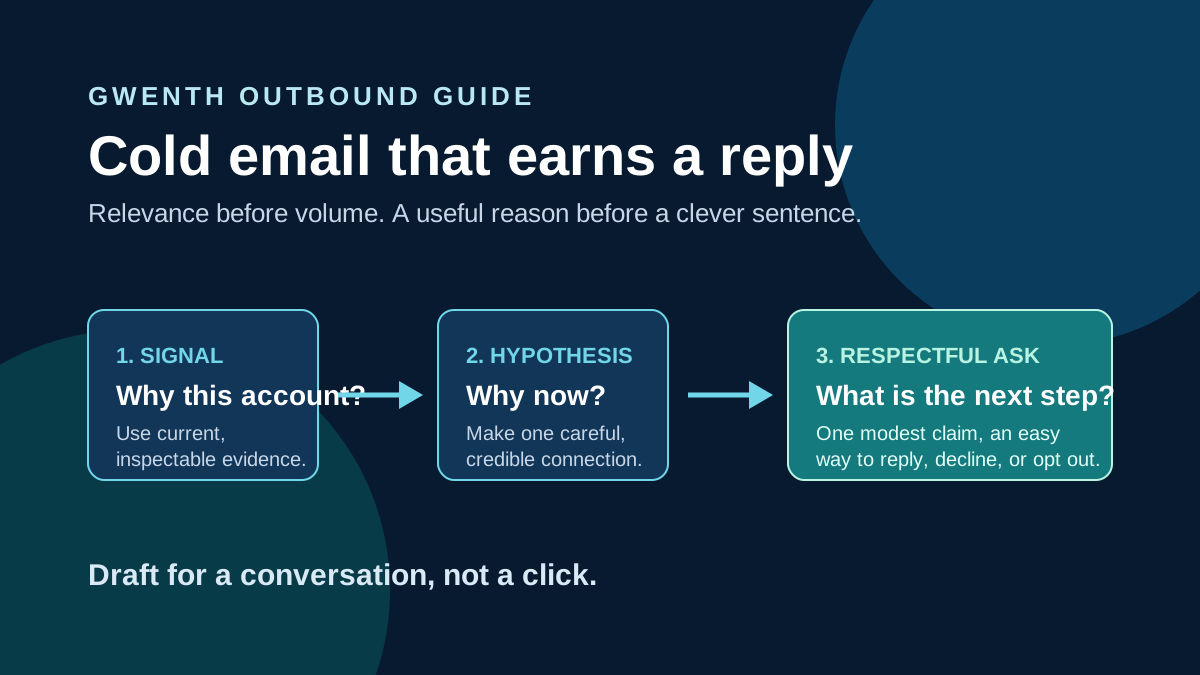
Most cold emails fail before the first sentence. The sender chose a person who has no reason to care, used a generic trigger, then tried to rescue the message with a clever subject line. That sequence is backwards. A strong cold email starts with a defensible reason to contact this account now. The writing only works after the reason exists.
This guide is for B2B teams that want to start useful conversations, not inflate send volume. It combines practical copywriting with deliverability and compliance fundamentals, because a message that is irrelevant, deceptive, or hard to decline is not a sustainable growth tactic. It is a future spam complaint.
Short answer
Draft a cold email around one specific, evidence-based reason the recipient may care now. Keep the subject honest, open with that reason, connect it to a plausible business problem, make a modest value claim, and end with a low-friction question. Use a real sender identity, make opt-out simple, and stop or change the sequence when the recipient replies. Before scaling, authenticate your sending domain, monitor complaints, and confirm the rules that apply in the recipient's jurisdiction.
What makes a cold email worth opening?
A cold email is an unsolicited first outreach message. That does not mean it has to be impersonal, misleading, or sent at industrial scale. The useful standard is simpler: would a reasonable recipient understand why they received this message, why the sender chose them, and what happens if they say no?
That standard is good copywriting, good deliverability hygiene, and good commercial judgment at the same time. It forces the sender to replace vague flattery with evidence, broad product claims with a narrow hypothesis, and aggressive calls to action with a genuine choice.
For Gwenth, the best starting point is a buying-window signal: a relevant change at the account that creates a reason for the conversation now. A hiring pattern, expansion, new market, leadership change, public launch, event participation, or workflow gap can be useful evidence. A company name pasted into a template is not evidence.
Start with the account, not the template
Before drafting, answer four questions in plain language. If you cannot answer them without guessing, do more research or choose a different contact.
- Why this account? Define the fit: market, operating model, customer type, or problem your offer can actually help with.
- Why now? Identify the recent or current signal that makes the conversation timely. Do not invent urgency because you need a campaign to send.
- Why this person? Tie the issue to the recipient's responsibility. A relevant problem for a company may still be irrelevant to a finance, product, security, or people leader.
- What is the smallest useful next step? Decide what a positive reply looks like before you write. A short answer, referral, permission to send a resource, or 15-minute conversation can all be legitimate next steps.
This is the difference between research and personalization. Research changes the decision to contact someone. Personalization changes the wording. When the decision is weak, a personalized opener merely makes the weak decision more visible.
The cold-email drafting framework
A useful first email can often fit in 90 to 160 words. Length is not a universal rule, but brevity helps when every sentence has one job. Use this five-part structure as a thinking tool, not as a script to copy word for word.
1. Use an honest subject line
The subject should set an accurate expectation. Name the relevant topic, account change, or outcome in ordinary language. Avoid fake reply prefixes, false urgency, bait-and-switch questions, or “quick question” when the email contains a product pitch. Deceptive subject lines create distrust and can create legal risk. In the United States, the FTC says a commercial email's subject line must accurately reflect the message content.
Good examples: “Hiring plans and outbound onboarding at [Company]” or “A question about [Company]'s expansion into [Market].” Weak examples: “Re: our meeting,” “You left this behind,” or “URGENT.” The good version does not guarantee an open. It earns the right to be evaluated honestly.
2. Open with the reason you wrote
Your first sentence should explain the observable context. Be precise enough to prove the note was considered, but do not perform surveillance. “I saw you are hiring five enterprise account executives” is useful if the information is public and it directly relates to the outreach angle. “I noticed your daughter attends…” is not relevant business context. Do not turn publicly available data into something that feels invasive.
A clear opening might be: “I noticed [Company] is expanding its commercial team in Singapore, which often makes pipeline coverage and follow-up consistency harder to manage.” It names an observable signal and a careful hypothesis. It does not pretend to know the recipient's internal priorities.
3. Connect the signal to a credible problem
Move from the observed change to a problem you can reasonably help solve. This is where many cold emails overreach. A new hire does not prove a company has a broken sales process. It may suggest the company is building capacity, which makes a question about onboarding, account prioritization, or CRM handoff reasonable.
Use conditional language where the evidence is incomplete: “Teams at this stage often run into…” or “I wondered whether…” The point is not to sound uncertain. The point is to be truthful about what you know and make room for the buyer's expertise.
4. Make one restrained value claim
Describe the outcome your product or service helps create, not a stack of features. One sentence is normally enough. For example: “Gwenth helps B2B teams turn account signals into prioritized outreach and carry the context through replies, meetings, and CRM follow-up.” That is clearer than listing AI, automation, enrichment, sequencing, analytics, and every integration in the first touch.
Do not manufacture social proof, claim results you cannot substantiate, or promise an outcome that depends on the buyer's market, data, and execution. Specificity is valuable only when it is true.
5. Ask for a low-friction next step
A cold email is not a contract. The CTA should fit the amount of attention you have earned. Invite a short conversation, ask whether the topic is relevant, or ask who owns the problem. Give the reader an easy way to decline. “Would a 15-minute comparison of your current workflow be useful next week, or is this not a priority?” is more respectful than “Book time on my calendar.”
One clear ask beats three competing asks. Do not ask the recipient to read a case study, watch a video, take a meeting, and forward your note. Choose the smallest action that lets the conversation progress.
A reusable first-email example
Subject: [Relevant business topic] at [Company]
Hi [First name],
I noticed [specific public signal]. Teams at that stage often need to [plausible workflow or outcome], especially when [relevant constraint].
Gwenth helps B2B teams turn account signals into prioritized outreach and keep the context moving through replies, meetings, and CRM follow-up.
Would it be useful to compare how your team handles [problem] today, or is someone else closer to this?
Best,
[Name]
[Role], [Company]
Notice what this example does not do. It does not exaggerate the signal, pretend the sender knows the buyer's priorities, hide the commercial purpose, or force a meeting. Its job is to make a relevant reply easy.
Personalization that improves the message
Useful personalization is evidence-led and tied to the offer. It could be a launch, expansion, job posting, event theme, public roadmap item, or current hiring priority. Generic lines such as “I loved your website” and “Congratulations on your recent success” are usually disposable because they do not explain why the sender wrote.
Be equally cautious with automated research. An AI system can summarize a website quickly, but a fluent summary is not proof. Check the underlying page, confirm the signal is current, and remove details that are not needed for the recipient to understand the relevance. Good outbound protects the buyer's time and the sender's reputation.
For a coordinated motion, the context must survive across channels. An email sent after a LinkedIn interaction should acknowledge the interaction when appropriate, and any reply should stop unrelated follow-ups. Otherwise the team creates the disconnected experience described in multi-channel outbound with shared context.
Draft for deliverability before you scale
Deliverability is not a trick for bypassing spam filters. It is the result of trustworthy identity, good recipient feedback, and technically sound sending. The copy affects that outcome because recipients decide whether a message is useful, ignored, deleted, unsubscribed from, or reported as spam.
Google requires all senders to Gmail accounts to meet baseline authentication and transport requirements, and requires more from bulk senders. Google says bulk senders must use SPF, DKIM, and DMARC, keep user-reported spam rates below 0.3%, and support one-click unsubscribe for applicable marketing and subscription messages. Even when your campaign is smaller, setting up SPF, DKIM, and DMARC, using a real From identity, and increasing volume gradually are sensible operating practices.
- Send from an identifiable person and company, with a monitored reply address.
- Authenticate the sending domain and keep the visible From domain aligned with your email setup.
- Start with carefully researched, small batches instead of suddenly sending high volume.
- Watch bounce, reply, unsubscribe, and spam-complaint signals. A high open rate does not excuse negative recipient feedback.
- Do not use deceptive sender names, misleading reply chains, link shorteners that obscure the destination, or content designed to evade filters.
Keep marketing and transactional traffic distinct. A password reset or receipt has a different purpose from prospecting or a newsletter. Mixing them makes it harder to honor recipient expectations and to diagnose delivery problems.
Compliance belongs in the draft, not just the footer
Commercial-email rules differ by country, recipient type, and context. This article is practical guidance, not legal advice. Before contacting people in a new market, have qualified counsel confirm the rules, lawful basis, disclosure, and recordkeeping required for your business.
Some baseline practices are broadly sensible. Use accurate From, Reply-To, routing, and subject-line information. Identify the commercial sender clearly. Include a valid physical postal address where required. Provide a working opt-out path and honor it promptly. Maintain a suppression list so a person who objects is not added back through a later campaign or data import.
For example, the United States CAN-SPAM Act applies to commercial messages, including B2B email, and the FTC describes requirements around identity, subject lines, a postal address, and opt-out. In the United Kingdom, the ICO distinguishes corporate subscribers from individuals and advises organizations to maintain a “do not email or text” list for corporate subscribers that object. These are not interchangeable global rules, which is exactly why teams should not treat a single template as universal compliance.
For promotional or subscription messaging that needs one-click unsubscribe, the technical standard is RFC 8058. Gmail's sender guidance says a body-link alone does not meet its one-click requirement; the relevant List-Unsubscribe headers must be implemented correctly. Your email provider or deliverability specialist can help configure this, but the business responsibility remains with the sender.
How Gwenth applies this
Gwenth helps B2B teams keep the account signal, the drafting context, and the relationship state in one workflow. Depending on the sources and channels a team connects, it can help prepare a signal-grounded draft, preserve the reason an account surfaced, and carry replies or meeting context into the next action. Teams remain responsible for checking evidence, approving sensitive actions, respecting contact preferences, and ensuring their sending setup and local legal obligations are appropriate.
Follow up with a reason, not pressure
A follow-up is not a license to repeat the same demand. Each message should add one useful angle: a different relevant signal, a concise resource, a narrowed question, or a polite close-out. If nothing new exists, a short final note that gives the recipient a clear opt-out is better than a six-message sequence that keeps asking “just bumping this.”
Set stopping rules before launch. Stop when someone replies, asks not to be contacted, is clearly the wrong person, or indicates the timing is wrong. Route a referral correctly. Record the outcome in the CRM. Founder-led teams especially benefit when automation protects these boundaries instead of creating more cleanup work, as we explain in founder-led sales automation.
Measure conversation quality, not just activity
Open rates are increasingly unreliable and do not tell you whether your outreach is welcome. Measure positive replies, qualified conversations, referrals, unsubscribes, complaints, bounces, and eventual pipeline quality. Review results by segment, signal, message hypothesis, and sender domain. A sequence that books a few meetings while generating many complaints is not a winning sequence.
Use the data to improve selection and drafting. If one signal produces thoughtful replies, investigate what makes it credible. If a job-title segment ignores messages, reassess the owner of the problem. If a specific opener causes opt-outs, remove it. The goal is not to optimize a sentence in isolation. It is to make the entire contact decision more respectful and more useful.
Cold-email pre-send checklist
- Can I explain why this account, why this person, and why now in one sentence each?
- Is every factual claim current, relevant, and verifiable from an appropriate source?
- Does the subject line honestly describe the message?
- Does the email make one modest, credible value claim rather than a list of features?
- Is there one low-friction CTA and an easy way to decline or opt out?
- Are the sender identity, reply address, domain authentication, physical-address, and unsubscribe requirements correct for this campaign?
- Will replies, objections, and opt-outs stop or change all related follow-up activity?
- Would I still send this message if the recipient published it internally with my name attached?
The standard to keep
Good cold email is a relevance test, not a writing contest. When the account selection is disciplined, the message can be short and calm. When the reason to reach out is weak, more copy only makes the weakness louder. Build the message around an honest observation, a useful hypothesis, and a simple next step. Then let the recipient decide.
Read next: why buying-window intelligence should shape the reason an outbound message exists in the first place.
Tags
References
Source material used for factual context in this article.
- Email sender guidelines
Google · Accessed
Sender authentication, complaint-rate, gradual-volume, and unsubscribe guidance for Gmail delivery.
- Email sender guidelines FAQ
Google · Accessed
Clarifies Gmail spam-rate expectations, DMARC alignment, and one-click unsubscribe requirements for applicable promotional traffic.
- CAN-SPAM Act: A Compliance Guide for Business
Federal Trade Commission · Accessed
United States guidance on commercial-email identity, subject lines, postal address, and opt-out obligations.
- Business-to-business marketing
Information Commissioner's Office · Accessed
United Kingdom guidance on B2B direct marketing, corporate subscribers, and suppression of objections.
- RFC 8058: One-Click Unsubscribe
IETF · Accessed
Technical standard for a one-click unsubscribe mechanism using the List-Unsubscribe-Post header.