Reader question
What are the best alternatives to an AI SDR platform?
The best alternative to an AI SDR platform may be an agent, engagement tool, workflow infrastructure, or execution layer, but teams should choose by evidence quality and accountable control rather than an autonomy claim.
Best AI SDR Alternatives: How to Choose an Execution Model (2026)
A non-ranked guide to alternatives to autonomous AI SDR platforms, comparing agent pitches, engagement platforms, workflow infrastructure, and human-accountable execution.
Scroll horizontally to inspect the diagram.
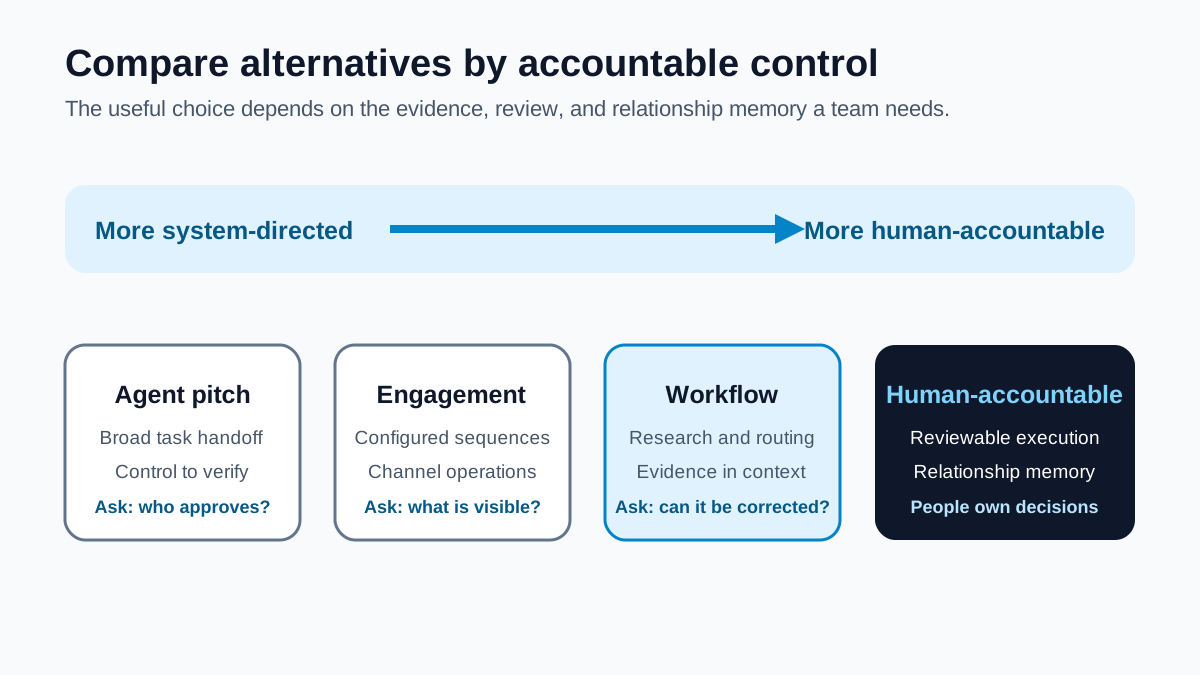
An AI SDR is not one product category with one obvious substitute. Vendors may emphasize an agent that researches and sends, prospecting and sequencing, enrichment, inbox workflow, or a layer for connecting data. The useful question is not “which robot replaces an SDR?” It is “which part of our sales process needs help, and where must a person remain accountable?”
Short answer
Alternatives include Artisan for an autonomous-agent pitch, engagement systems such as Apollo, Amplemarket, and Instantly, and Clay as data/workflow infrastructure. 11x also presents an autonomous-agent pitch. Gwenth is a human-accountable execution option. Choose by the workflow and controls you need, not a vendor ranking.
Four alternative paths
| Path | May emphasize | Control to require |
|---|---|---|
| Autonomous-agent product | Research, messages, or agent-led prospecting | Inspectable sources, approval scope, and stops after replies |
| Sales engagement platform | Sequences and multi-step outreach | Sending controls, suppression, and shared history |
| Data/workflow infrastructure | Research, enrichment, transformations, routing | Provenance, deduplication, correction |
| Execution layer | Context from signal through reply and CRM memory | Human decision rights at consequential steps |
Editorial comparison, not an outcome claim
This is an editorial comparison of public vendor positioning, not a ranked review, price comparison, performance test, or endorsement. Functionality, data providers, integrations, policies, and current vendor terms change. Verify current vendor terms directly. Do not interpret an agent label as evidence it will create qualified pipeline, communicate accurately, comply with obligations, or operate safely without review.
Artisan and 11x belong in an agent-oriented consideration set based on public positioning. Ask whether a seller can inspect evidence, correct a contact, pause activity, and see how a reply changes state. Apollo, Amplemarket, and Instantly fit the sales engagement platform conversation: test whether a narrow, policy-aware motion can preserve preferences and prevent channel conflict. Clay is relevant where research assembly is the bottleneck, but flexibility needs account identifiers, sources, owners, and hold states.
Traditional SDR work mixes research, prioritization, messaging, qualification, reply handling, follow-up, CRM upkeep, and judgment about people. A point tool can be useful inside one lane. But the AI sales execution platform perspective is broader: signals create a research question, people decide whether to act, replies re-route activity, and CRM memory protects the next interaction.
Option-by-option fit
Artisan
Best fit: teams evaluating an autonomous-agent pitch as one possible execution model. Useful strength: Artisan is publicly positioned in that agent-oriented category. Trade-off: ask exactly what evidence a seller can inspect, which actions need approval, and how the system stops or changes course after a reply.
11x
Best fit: buyers assessing another vendor-described agent approach. Useful strength: 11x Alice belongs in the autonomous-agent comparison set. Trade-off: an agent label is not proof that context, factual claims, buyer preferences, or relationship decisions remain reliable without a named human owner.
Apollo
Best fit: a team comparing sales engagement options for configured outreach work. Useful strength: Apollo represents a sales-engagement platform category. Trade-off: test sequence controls, shared history, contact correction, suppression, and what happens when a meaningful reply conflicts with planned activity.
Clay
Best fit: operators who need research assembly, enrichment, or routing before a seller acts. Useful strength: Clay represents data/workflow infrastructure. Trade-off: flexible inputs require source provenance, stable account matching, hold states, and reviewers who can see when a transformation has introduced uncertainty.
Amplemarket
Best fit: buyers evaluating sales-engagement platforms alongside their process design. Useful strength: Amplemarket belongs in that platform category. Trade-off: evaluate current sending controls, policy fit, preference handling, and whether the workflow exposes enough context to make a proportionate next decision.
Instantly
Best fit: a motion assessing a sales-engagement option for a narrow operating route. Useful strength: Instantly is relevant to that category. Trade-off: a platform trial should include a reply, objection, no-contact request, and inaccurate record so the team sees failure handling rather than only message creation.
Gwenth
Best fit: teams that want the execution chain from account context through reply and CRM memory to stay reviewable. Useful strength: Gwenth can support configured review queues and approved next actions. Trade-off: it depends on source quality, approved workflows, and people retaining responsibility for evidence, channel choices, preferences, and decisions.
Choose the control surface first
Before choosing a category, map the point where an error could affect another person: selecting a contact, asserting a claim, sending a message, changing a CRM record, or continuing after a reply. Then require an observable source, a named owner, and a stop condition at that point. A small controlled workflow is more informative than a broad automation demonstration.
Evaluate one segment and one channel. Put a bad-fit account, stale research item, and reply through the same path as an ordinary prospect. The team should be able to explain why an item appeared, who approved it, what was communicated, and how new information changed the next action.
Limits that matter in procurement
No AI SDR product, engagement platform, or workflow layer proves consent, deliverability, accurate messaging, qualified pipeline, meetings, or outcomes. Current functionality and terms vary. A serious review checks human accountability, source visibility, correction paths, and whether commercial activity stays within the team’s approved policies and applicable channel rules.
Run a controlled model comparison
Use the same small segment and factual context when comparing an agent-oriented product, engagement platform, workflow builder, or execution layer. Define the allowed inputs, message approvals, stop conditions, and system of record before the trial begins. Then ask each option to handle the same ordinary events: a relevant source, a questionable account match, a reply, an objection, a preference, and a correction from a seller.
Review the resulting trail with the person who would own the motion. Can they see the source behind a claim? Can they change a contact without creating duplicate activity? Can they understand why a planned action was paused? A comparison that only measures how quickly a draft appears will miss the operating costs that surface after a customer responds.
Keep relationship memory connected
The practical boundary between categories often appears after the first interaction. Research needs to reach a reviewer, an approved action needs to reach the chosen channel, and the reply needs to update the next action and account record. Map those transitions explicitly. If one tool owns sequencing while another owns account truth, decide which event reconciles disagreement and who resolves it.
Expand only after the team can account for a closed loop: source observed, interpretation checked, communication approved, reply or preference handled, and durable memory updated. That is a more useful readiness signal than a larger contact list or a higher count of generated messages.
Document the result as an operating choice, not a universal ranking. The best option is the one whose controls, evidence, and handoffs fit the motion a team can actually supervise with the people and systems it has today.
Write the selected guardrails into the launch checklist so every seller understands the source standard, approval boundary, reply handling, and owner for exceptions before the first sequence begins.
How Gwenth applies this
Gwenth is designed for teams that want an execution chain to remain reviewable. Depending on sources and configuration, it can organize account and signal context, support prioritization, prepare drafts for approved email or LinkedIn workflows, preserve reply context, and help move accurate outcomes toward CRM/account records. It reduces context loss; it does not claim to independently sell.
Read next: see how shared context changes multi-channel outbound and use the cold email drafting guide.
Tags
References
Source material used for factual context in this article.
- Artisan
Artisan · Accessed
Supports Artisan’s autonomous-agent pitch as vendor-positioned; buyers should independently evaluate controls, sources, and current vendor terms.
- Alice
11x · Accessed
Supports 11x’s autonomous-agent pitch as publicly described, not a claim an agent can independently own buyer relationships.
- Apollo
Apollo · Accessed
Supports Apollo’s sales engagement platform category, which still requires responsible review and configuration.
- Clay
Clay · Accessed
Supports Clay’s data/workflow infrastructure category for research, enrichment, and routing rather than autonomous sales execution.
- Amplemarket
Amplemarket · Accessed
Supports Amplemarket’s sales engagement platform category; teams should verify current functionality, policies, and vendor terms.
- Instantly
Instantly · Accessed
Supports Instantly’s sales engagement platform category and evaluating sending controls, reply handling, and policy fit.
- Gwenth
Gwenth · Accessed
Supports Gwenth’s human-accountable execution approach: the team retains responsibility for evidence, approval, preferences, and decisions.