Reader question
How can one founder run outbound without hiring SDRs?
Founder-led sales should preserve founder judgment while removing founder-operated admin. The system should research, draft, remind, route, and follow up around the founder.
Founder-Led Sales Should Not Mean Founder-Operated Sales
Founders should own judgment, positioning, and the hard calls. They should not spend their best hours copying notes, chasing reminders, and manually stitching tools together.
Scroll horizontally to inspect the diagram.
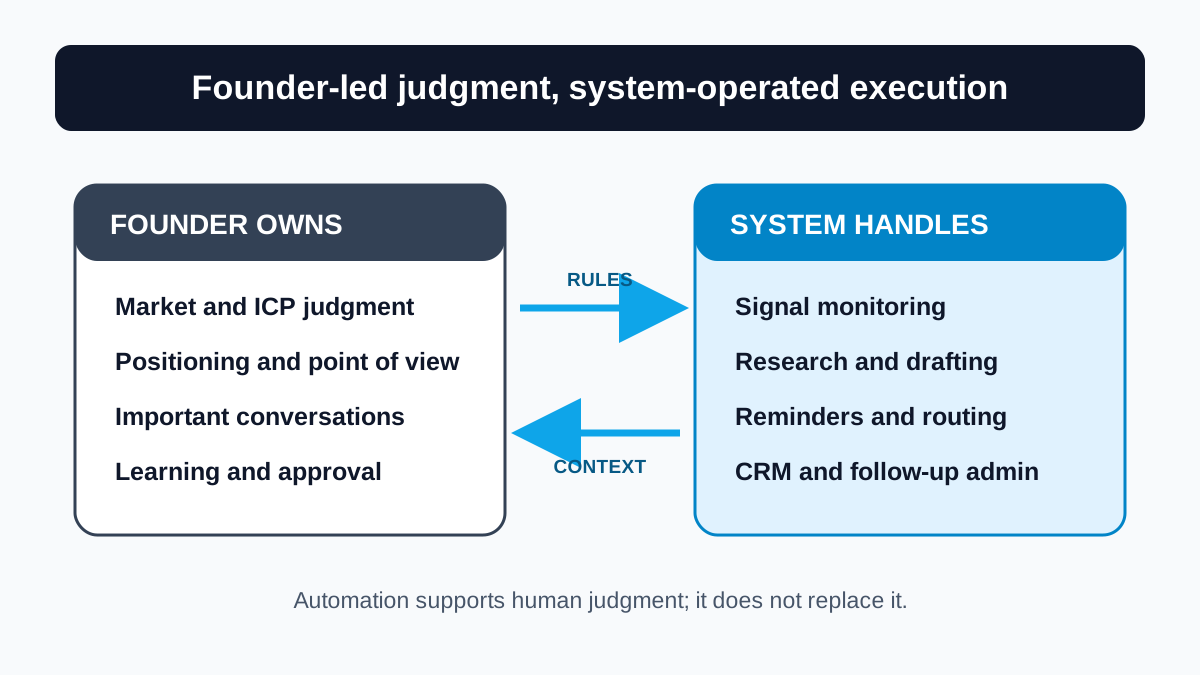
Founder-led sales is good. Founder-operated sales is a tax. A founder should stay close to the market, hear objections, refine positioning, decide which customers not to serve, and lead the conversations that shape the company. That does not mean the founder should spend the evening rebuilding account research, copying notes into the CRM, checking three inboxes, and remembering every follow-up.
The goal of automation is not to remove the founder from early sales. It is to protect the founder’s judgment from clerical fragmentation. When the market, offer, and qualification logic are still changing, fully unattended execution can scale the wrong lesson faster. A better design makes the system responsible for preparing and preserving context while the founder remains accountable for choices.
Short answer
One founder can run a focused outbound motion without immediately hiring SDRs by separating judgment from repeatable support work. The founder defines the ICP, point of view, exclusions, approval rules, and qualification questions. A configured system can organize signal and account context, support prioritization and drafts, unify replies, prepare meeting context, maintain CRM/account records, and surface next actions. The founder still verifies evidence, approves consequential outreach, handles real conversations, and owns compliance.
Founder-led and founder-operated are different models
Founder-led means the founder owns the market thesis and the learning loop. Founder-operated means every step depends on the founder remembering and performing it manually. The first is a strategic advantage at an early-stage company. The second creates a queue that grows faster than the founder’s attention.
Automation should therefore be designed around decision rights. The NIST AI RMF Playbook emphasizes accountable roles, human-AI configurations, and governance appropriate to context. In practical sales terms: write down what the system may prepare, what it may update, what needs review, and what only a person may decide.
A founder-led, system-supported operating model
- Define a narrow account thesis. Describe the companies you can help, the buyer role, the problem, the evidence that makes the problem timely, and obvious disqualifiers. “B2B SaaS” is not narrow enough to produce a useful message.
- Build a review queue from evidence. Use connected signal and account context to rank accounts for attention. Keep the source, date, and inference visible. The queue is a shortlist for judgment, not a list of people who have expressed intent.
- Create reusable message logic. Write the point of view once: the change you observe, the problem it may create, the value you can offer, and the low-pressure next step. Let drafts adapt that logic to verified account facts rather than invent novelty for every contact.
- Set approval and stop rules. Decide which drafts require founder review, what happens after a reply, how opt-outs are honored, when an account is disqualified, and how channel activity is paused. A lean team needs fewer ambiguous states, not more automation branches.
- Turn meetings into structured learning. Before a call, review the source evidence, message history, known roles, and questions to test. After it, record what changed in your understanding, what was promised, and the next action. That information should refine the ICP and future review criteria.
- Review the motion weekly. Inspect why accounts were prioritized, which assumptions were wrong, where replies were mishandled, and which tasks still depended on memory. Improve the rule or template before adding volume.
An illustrative week for one founder
Imagine a fictional founder selling developer tooling to small infrastructure teams. On Monday, the review queue contains twelve accounts with recent platform-engineering hiring evidence. The founder verifies four, rejects five as poor fits, and leaves three for research. The system prepares drafts that connect the public role requirements to the founder’s actual point of view; the founder edits and approves the messages that are appropriate.
On Tuesday, one buyer replies with a technical question. The planned follow-ups pause, the reply appears with the original account context, and the founder answers directly. A meeting is booked for Thursday. Its brief carries the job-post evidence, the exact message thread, and three questions the founder wants to test. After the call, the record notes that the team’s real concern is migration risk—not the hiring pressure the founder first inferred—and creates a next action to send architecture material. That correction is the valuable output. The workflow helped the founder learn without pretending the original signal predicted a deal.
What should never be delegated blindly
Founders remain responsible for the truth of the message and the way it reaches people. In the United States, the FTC’s CAN-SPAM compliance guide explains that commercial email requirements include accurate routing information and subject lines, a valid address, and a working opt-out; it also notes that business-to-business email is not exempt. Other jurisdictions and channels have their own rules. This article is operating guidance, not legal advice.
- Do not allow drafts to claim a conversation, event encounter, technology choice, or business problem that the evidence does not establish.
- Do not send WhatsApp outreach without the required recipient permission and policy-compliant route.
- Do not use unauthorized automation on platforms that prohibit it.
- Do not let a system turn silence into escalating pressure across channels.
- Do not write inferred qualification into the CRM as confirmed buyer fact.
How Gwenth applies this
Gwenth supports the founder-led model by keeping available account and signal context close to prioritization, email and LinkedIn workflow context, unified reply handling, meeting context, CRM/account records, and next-action support. Which evidence appears and which actions are available depend on the sources, connections, permissions, and workflow rules the team configures.
The founder can use that shared context to review why an account surfaced, adjust a draft, take over a reply, prepare for a meeting, and preserve what was learned. Gwenth does not replace the founder’s market judgment, determine that an account intends to buy, guarantee delivery or conversion, or make channel permissions automatic. Its job is to reduce context rebuilding so the founder’s limited attention goes to decisions and conversations.
Read next: see why multi-channel outbound fails when channels do not share memory, and how a self-updating CRM workflow can preserve what the founder learns.
Tags
References
Source material used for factual context in this article.
- NIST AI RMF Playbook
National Institute of Standards and Technology · Accessed
Supports defining accountable human roles, oversight, and context-specific controls when AI assists an operating workflow.
- CAN-SPAM Act: A Compliance Guide for Business
Federal Trade Commission · Accessed
Supports the U.S. commercial-email guardrails discussed here, including accurate identity and subject lines, opt-outs, and sender responsibility.