Reader question
What is the best buying signal software for a B2B sales team?
The best buying-signal software is not a universal winner: it is the system whose evidence, fit model, workflow handoff, and human controls match a team’s sales motion without turning probabilistic activity into a claim of intent.
Best Buying Signal Software for B2B Teams (2026)
A practical comparison of buying-signal software categories, their evidence limits, and the human review controls a lean B2B team needs before acting.
Scroll horizontally to inspect the diagram.
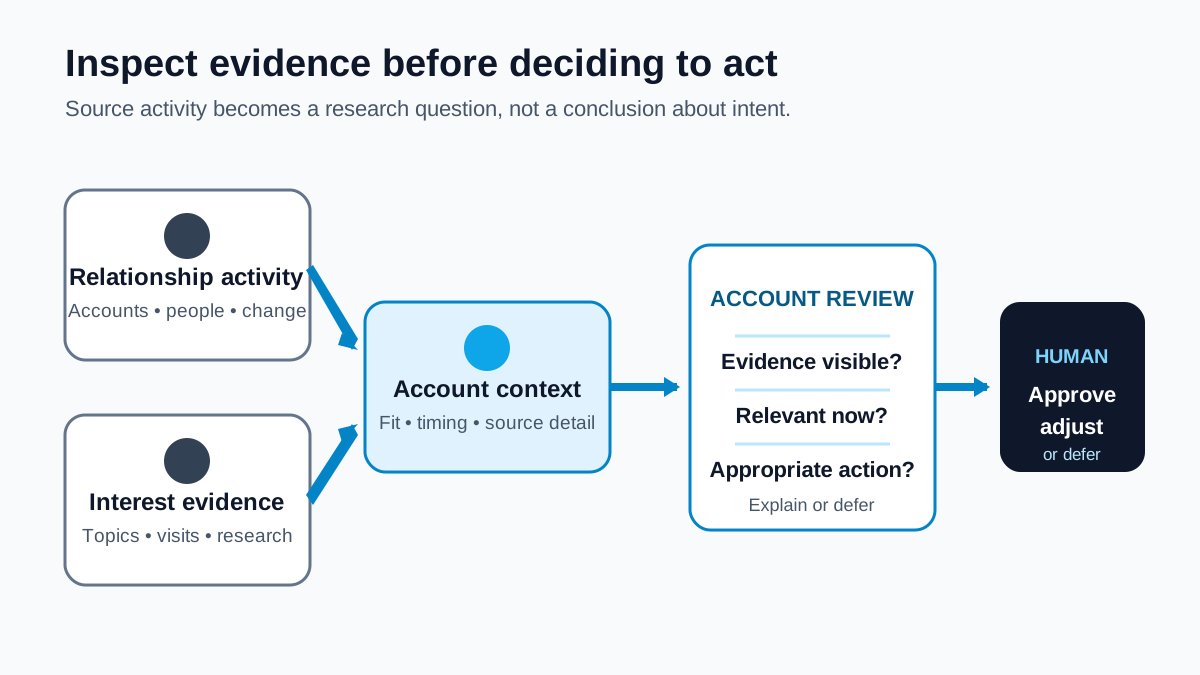
There is no universally best buying signal software. The best fit depends on the evidence a team trusts, the accounts it can serve, where sellers work, and how much review is needed before an action. A tool can be excellent at broad research but poor for a motion that requires seller-visible sources and a clear explanation for every account.
Short answer
Choose by evidence and workflow, not a ranking. LinkedIn Sales Navigator supports LinkedIn-native signal research. 6sense and Bombora offer intent data; G2 Buyer Intent adds review-site intent. Clay is data/enrichment workflow infrastructure, while Apollo combines integrated prospecting/sequencing. Gwenth is a human-reviewed execution layer beside chosen sources. None proves an account will buy.
Signal categories to compare
| Category | Useful for | Question before action |
|---|---|---|
| Social and relationship research | Watching named accounts and visible changes | Is this public observation relevant to our ICP? |
| Account-level intent | Prioritizing patterns worth research | What does the provider measure, and is it timely? |
| Review-site engagement | Adding marketplace behavior to account context | Does it support a proportionate next step? |
| Workflow infrastructure | Joining sources, enrichment, routing, and review | Can we retain provenance and correct errors? |
Categories overlap. A team may use a social observation for timing, intent data for a research queue, enrichment to resolve a contact, and its CRM for relationship memory. Trouble begins when the stack hides who decided the account mattered or which source established the narrative.
Editorial comparison, not a ranking
This is an editorial comparison of public product descriptions, not a benchmark, procurement recommendation, or performance claim. Capabilities, integrations, coverage, policies, and current vendor terms change. Confirm current vendor terms, data handling, contract conditions, and implementation fit directly with each provider. We do not assign rankings because a broad signal feed, a flexible workflow builder, and an engagement tool solve different problems.
Ask every vendor the same operating questions: Can a seller inspect the source? Does the account event retain a date? Can duplicate observations be resolved? What happens after a reply or preference? Is there a human owner for proposed action? A dashboard that gives a score without these answers is a prioritization prompt, not a complete sales decision system.
The broader AI sales execution platform perspective matters because source, review, draft, reply, and CRM memory should stay connected. More data does not help when it makes a team less able to explain or correct outreach.
Option-by-option fit
LinkedIn Sales Navigator
Best fit: teams whose sellers already use relationship research around named accounts. Useful strength: LinkedIn Sales Navigator is relevant for LinkedIn-native account monitoring and relationship context. Trade-off: visible activity still needs an ICP judgment, a dated note, and a decision about whether any action is appropriate.
6sense
Best fit: teams evaluating account-level intent as one research input across a defined segment. Useful strength: 6sense represents an intent-data category that can help prioritize where to investigate. Trade-off: aggregated activity is not a verified buyer decision, so sellers need a source-aware follow-up question rather than a confidence theater score.
Bombora
Best fit: a motion that wants another account-level topic signal beside its own evidence. Useful strength: Bombora belongs in the intent-data comparison set. Trade-off: assess coverage, recency, account matching, and how a team will distinguish a research cue from a reason to contact a particular person.
G2 Buyer Intent
Best fit: teams that want review-site engagement included in account context. Useful strength: G2 Buyer Intent provides a distinct marketplace-engagement category. Trade-off: a visit or comparison activity can be useful context, but it does not identify a buyer’s authority, timing, permission, or preferred channel.
Clay
Best fit: operators whose bottleneck is assembling, enriching, and routing evidence across systems. Useful strength: Clay represents data and workflow infrastructure. Trade-off: flexibility increases the need for stable account identifiers, source retention, deduplication, and an owner who can correct a bad transformation.
Apollo
Best fit: teams considering integrated prospecting and sequencing beside their signal research. Useful strength: Apollo belongs in a conversation about integrated prospecting/sequencing. Trade-off: a combined workflow still needs controls for source quality, message approval, replies, preferences, and the truth retained in the account record.
Gwenth
Best fit: a team that wants a human-reviewed execution layer around configured sources. Useful strength: Gwenth can organize reviewable account context and approved next actions. Trade-off: its usefulness depends on connected-source quality, configuration, and people who verify evidence and own commercial decisions.
Make a signal queue explainable
For every shortlisted account, preserve the observed source, date, account match, and the precise question a seller must answer. A job post, announcement, topic pattern, or review-site event can justify research; it does not establish intent or permission. The reviewer should be able to hold, revise, disqualify, or suppress an item without losing the reason it appeared.
Run one source type through a small queue before combining feeds. Include a stale event, a deliberate bad match, and an account that fits on paper but should not receive outreach. This exposes whether the workflow makes uncertainty visible or merely turns noisy evidence into a polished narrative.
Limits that matter in procurement
No signal provider, enrichment record, or score proves a purchase, contact permission, message accuracy, deliverability, meeting, or commercial outcome. Coverage and integrations change. Treat demonstrations as a chance to reconstruct a real account decision, including who can correct evidence and what stops conflicting activity after a reply or stated preference.
Build the evaluation scorecard around evidence
Use a short scorecard that separates source quality from account fit. For each candidate workflow, record what the provider observed, when it was observed, whether the account match is credible, what a seller can inspect, and which system will remember the result. Then score the operating design: Does it put the right accounts in a bounded queue? Can a reviewer explain a hold? Can a correction prevent repeat work? Can the team see the source after a CRM handoff?
Do not let a provider’s internal score become the only input. Ask how the score is made available, how it changes over time, and how a user can record disagreement. A team may reasonably use a broad intent pattern to decide where to research while declining to act when the public account evidence is weak. That distinction protects both sales focus and the buyer experience.
Define the handoff before adding another feed
Decide where a reviewed signal becomes durable account memory. The handoff should retain the account, source, date, reviewer decision, and next action rather than copying an unqualified narrative. If a seller cannot later tell whether a signal was accepted, deferred, or disproved, the stack is accumulating activity without learning. Start with one source and one handoff; expand only when the team can audit that loop.
At the end of the pilot, keep a short ledger of accepted, held, and rejected observations. The pattern of those decisions reveals whether a source is improving research focus or merely increasing a queue. Use that evidence to refine the evaluation before expanding coverage.
How Gwenth applies this
Depending on connected sources and configuration, Gwenth can organize account and signal context into a reviewable workflow, support prioritization, prepare drafts for approved email or LinkedIn work, preserve reply context, and carry useful outcomes toward CRM/account records. It does not claim that a signal predicts a purchase or that sales can operate without people.
Read next: apply a buying-signal scorecard and compare signal-based prospecting with intent data.
Tags
References
Source material used for factual context in this article.
- Sales Navigator
LinkedIn Sales Navigator · Accessed
Supports LinkedIn-native signal research, account monitoring, and relationship context rather than a claim that activity proves buying intent.
- Intent Data
6sense · Accessed
Supports intent data as an account-activity category and research input that still needs fit and human interpretation.
- Intent Data
Bombora · Accessed
Supports intent data source comparison and the limitation that aggregated interest is not verified purchasing intent.
- Buyer Intent
G2 Buyer Intent · Accessed
Supports review-site intent as an engagement signal that can inform research without establishing an individual buyer decision.
- Signals
Clay · Accessed
Supports data/enrichment workflow infrastructure for assembling, transforming, and routing source evidence across tools.
- Buying Intent Overview
Apollo · Accessed
Supports integrated prospecting/sequencing as a workflow category rather than a conclusion about a specific account.
- Gwenth
Gwenth · Accessed
Supports Gwenth’s human-reviewed execution layer: organize evidence for review and approved action, not autonomous purchase prediction.