Reader question
How should a B2B sales team score buying signals?
A useful buying-signal score is a transparent review aid, not a prediction engine: it weighs ICP fit, timing evidence, evidence quality, and actionability so sellers can focus judgment where it matters.
A Practical B2B Buying Signal Scoring Framework
A buying-signal score should make account review more consistent, not pretend to predict who will buy. Use fit, timing, evidence quality, and actionability to decide what deserves a human look next.
Scroll horizontally to inspect the diagram.
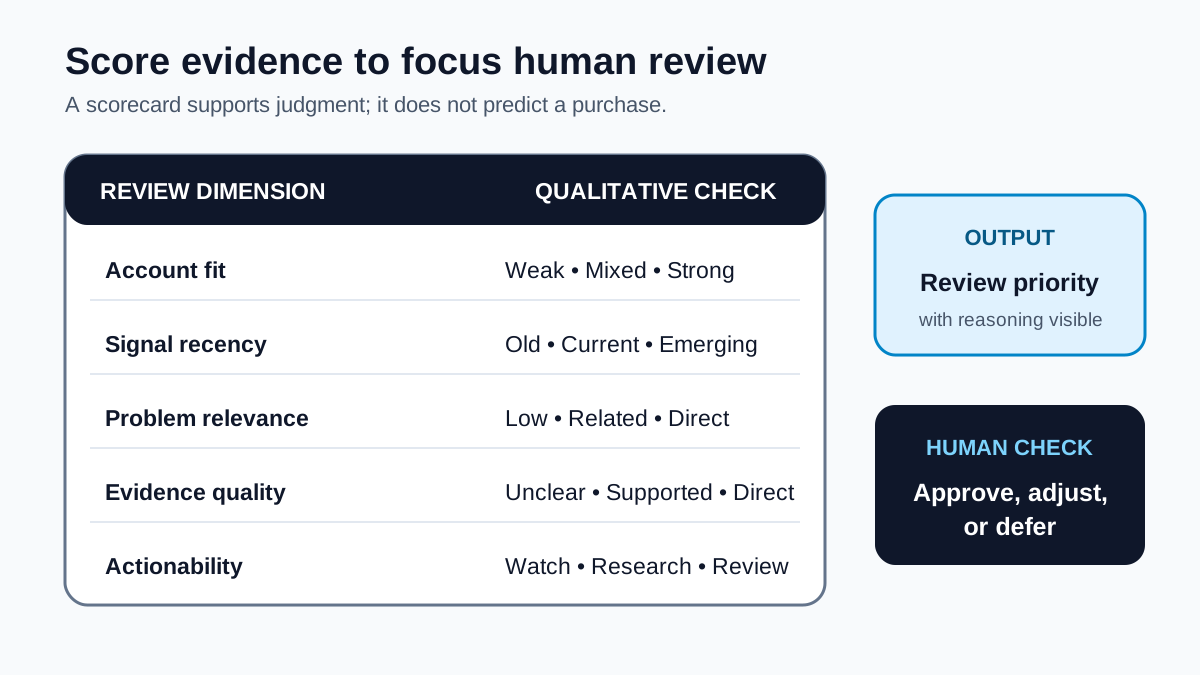
A score should make prioritization clearer, not make sales judgment disappear. B2B teams collect more account activity than anyone can thoughtfully review: job posts, leadership changes, funding news, filings, event conversations, product launches, and changes on a company website. The question is not whether every observation is interesting. It is whether the evidence gives a seller a responsible reason to look closer.
Short answer
Score B2B buying signals with four qualitative dimensions: ICP fit, timing evidence, evidence quality, and actionability. Use the score to create a review queue, then let a person verify the account, decide whether the evidence is relevant, and disqualify weak or inappropriate opportunities. Signals do not prove purchase intent; they only help a team decide what to investigate next.
This is Gwenth editorial methodology, not a universal predictive model. It does not validate an account's future behavior, replace account research, or establish that a buyer wants contact. Its value is practical: it makes the reasons behind a priority visible enough to challenge, improve, or reject.
Start with a review question, not a number
Many scoring systems fail because they turn every observation into a high-precision-looking number. A score of 87 can feel authoritative even when its inputs are stale, unrelated to the offer, or drawn from a weak source. A better starting question is: “Does this account deserve a human review now, and why?”
That framing changes the job of a score. It is not a promise that an account will buy. It is a compact record of the evidence available today. A team can use a simple low, medium, or high assessment for each dimension, or define internal points if that makes triage easier. What matters is that people can see the inputs, revise them, and say no.
Dimension 1: ICP fit
ICP fit asks whether the account resembles a customer your team is prepared to serve. It is not a demand signal. It is a guardrail against spending time on an account whose industry, company profile, operating model, geography, or buyer role does not suit the offer.
- High fit: the account matches a documented market, has a plausible buyer role, and has a use case your team can explain clearly.
- Medium fit: parts of the profile match, but key details are unknown or the use case needs validation.
- Low fit: the account is outside the market, lacks a plausible use case, or should be excluded by your team's own criteria.
Fit should be specific enough to guide a seller, not a pile of decorative firmographics. For example, a cybersecurity vendor might care about the security function, regulatory environment, and operating scale; an HR software team might care about hiring cadence, workforce complexity, and geographic expansion. Vertical signal intelligence matters because the same observation can have a different meaning in each market.
Dimension 2: timing evidence
Timing evidence asks whether something material changed recently enough to create a legitimate research question. A new job posting, a stated expansion, a leadership appointment, a product launch, or a conversation at an event may be relevant. The connection to the offer still needs to be reasoned through; novelty by itself is not urgency.
Public sources can provide useful starting points. The U.S. Bureau of Labor Statistics Job Openings and Labor Turnover Survey and the SEC's Search Filings are examples of public evidence sources. They can help a researcher understand market or company context, but neither turns a broad trend or filing into proof that a particular account is buying.
Use timing evidence to ask a narrow question: what changed, when did it change, and what would make it relevant to this buyer? If the answer is vague, lower the assessment or route it to research rather than outreach. For the broader distinction, see how buying-window intelligence frames timing.
Dimension 3: evidence quality
Evidence quality asks how much confidence the team should place in the observation itself. Direct, attributable, current evidence is stronger than a rumor, a scraped fragment, or an inference copied across sources. Capture the URL or source, observation date, and a short note about what was actually observed. That makes a future reviewer able to separate the fact from the interpretation.
- High quality: a recent, attributable primary source or a clearly recorded first-party conversation.
- Medium quality: a reputable secondary source, an incomplete public artifact, or a source that needs confirmation.
- Low quality: an undated claim, unattributed aggregation, or an inference without inspectable evidence.
Strong evidence is not automatically strong intent. It simply gives the reviewer a better foundation. Signal-based prospecting and intent data should be treated as different inputs, each with their own limits.
Dimension 4: actionability
Actionability asks whether a seller can take an appropriate next step now. The account may have fit and credible timing evidence but still be non-actionable if there is no responsible audience, no clear research path, a do-not-contact instruction, or no way to connect the observation to a useful conversation.
High actionability means the team can name a next action and its purpose: verify an account fact, prepare for a requested conversation, follow up after a real interaction, or share a relevant resource where it is appropriate to do so. Low actionability means the evidence belongs in monitoring, not a sequence. Treat permission, preferences, and internal exclusion rules as hard constraints rather than score deductions.
A fictional, illustrative example
Here is a fictional, illustrative example, not a customer story or forecast. Imagine “Northstar Systems,” a made-up HR software company. A researcher finds a recent public careers page listing payroll implementation roles in two new countries. The company fits the team's defined market, so ICP fit is high. The expansion is recent and connected to a plausible workflow challenge, so timing evidence is medium to high. The careers page is attributable but does not explain the buying plan, so evidence quality is medium. The researcher can identify a likely operations owner and a relevant question, but there has been no prior conversation or expressed interest, so actionability is only medium.
The appropriate outcome is not “send a high-pressure campaign.” It is “have a human verify the details, check internal policies and contact preferences, and decide whether there is a useful, welcome next step.” If the role is unrelated, the evidence is old, or no appropriate route exists, disqualify the item. The score has done its job by making the uncertainty obvious.
Human review and disqualification are part of the framework
Every score needs a way to be overturned. Require a human to inspect the source, compare it with the account record, and record the outcome: pursue, monitor, research further, or disqualify. Disqualification is not failure. It protects the team's attention and keeps weak evidence from becoming a false narrative.
Useful disqualification reasons include poor fit, stale evidence, an unrelated change, duplicate records, lack of a responsible next step, a stated preference not to be contacted, or a claim that cannot be verified. Reviewers should be able to add a reason the model did not anticipate. The larger sales execution workflow is stronger when it preserves that human judgment from signal through CRM memory.
Common mistakes to avoid
- Confusing visibility with intent: a public change may be worth research without indicating a buying decision.
- Double-counting one story: several articles repeating the same announcement are not independent evidence.
- Hiding weak sources behind a total: keep the source and confidence visible beside the score.
- Letting a high score bypass review: the score prioritizes work; it does not authorize contact or replace judgment.
- Ignoring negative evidence: record exclusions, stale signals, and disqualifications so the queue improves over time.
How Gwenth applies this
Gwenth can organize available account and signal context into a review queue, preserve source provenance, and support a team's own fit, timing, evidence-quality, and actionability rules. Depending on connected sources and configuration, a reviewer can carry that context into email or LinkedIn workflow drafts, meeting preparation, unified reply handling, next-action support, and CRM/account records. The framework remains a prioritization aid: Gwenth does not prove purchase intent, establish permission, guarantee data completeness or sales outcomes, or remove the need for human verification and disqualification.
A simple operating rhythm
Review new observations regularly, assess the four dimensions in plain language, and route only the strongest items to a named human owner. That owner verifies the evidence and chooses the smallest appropriate next action. Record the result and revisit the framework when the team notices a repeated false positive or an overlooked pattern. The goal is not a perfect score. The goal is a calmer, more inspectable way to choose what deserves attention.
Read next: use the framework alongside buying-window intelligence so a timing observation becomes a reviewable account decision, not a claim of certainty.
Tags
References
Source material used for factual context in this article.
- Job Openings and Labor Turnover Survey
U.S. Bureau of Labor Statistics · Accessed
An example public source for labor-market context; it is not account-level proof of buying intent.
- Search Filings
U.S. Securities and Exchange Commission · Accessed
An example public source for company disclosures that may warrant human review.