Reader question
How should AI prepare a sales meeting from account intelligence?
AI meeting prep should not summarize a website in isolation. It should carry forward the buying signal, the outreach history, account evidence, likely discovery angles, and follow-up path.
Meeting Prep Should Start With Sales Intelligence, Not a Blank Page
The best meeting brief carries forward the signal, account context, conversation history, likely pains, and follow-up path before the call starts.
Scroll horizontally to inspect the diagram.
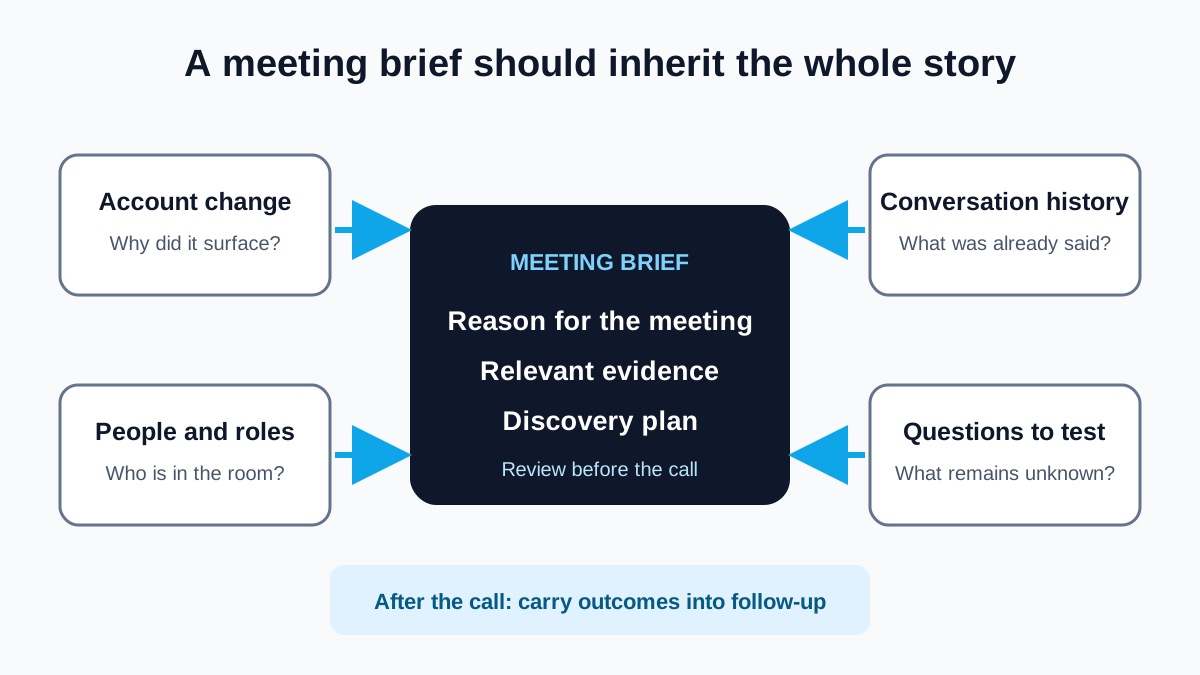
A sales meeting should not start with a blank page, and it should not start with an unverified AI summary. If the system already holds the reason an account surfaced, the source behind that reason, the conversation history, and the people involved, a meeting brief should carry that context forward. Its job is to help the seller enter with continuity and better questions—not to tell the seller what the buyer thinks.
Short answer
AI meeting prep should connect five layers: evidence, account context, stakeholder context, questions, and possible next actions. It should distinguish sourced facts from hypotheses, summarize relevant relationship history, identify gaps, and suggest questions that let the buyer confirm or correct the picture. The seller remains responsible for judgment during the conversation and for deciding what belongs in the CRM afterward.
Start with evidence, not a company summary
A generic website summary can describe a company’s product and industry, but it rarely explains why a particular meeting exists. Begin with attributable evidence: a buyer’s reply, a referral, a real event conversation, a company announcement, a public filing, a relevant careers-page change, or an explicit request. Record the source, date, and exact observation. If the evidence comes from a public filing, the SEC’s Search Filings service is an example of a primary source a seller can inspect directly.
Then label the inference. “The company announced entry into two markets” may be a fact. “The operations team must need our category now” is a hypothesis. The brief should preserve that boundary because discovery exists to test it. Without the boundary, the seller can enter the call repeating a confident story the buyer never told.
Layer 1: evidence and why now
The evidence section should answer four questions: what was observed, where it came from, when it was observed, and why the team thinks it may matter. Add counter-evidence when available. A recent signal may be unrelated; a conversation may have moved in a different direction; an announcement may describe a plan that has already changed.
A useful brief makes freshness and confidence visible. It can say “public source, checked yesterday,” “buyer-confirmed in email,” or “hypothesis—verify on the call.” The UK Government’s Data Quality Framework describes quality as fitness for purpose and stresses metadata, lifecycle assessment, and transparent communication. Applied here, a meeting brief should tell the seller whether each item is suitable for opening a conversation, only for background, or not reliable enough to use.
Layer 2: account context
Account context connects the observation to the company’s operating situation. Include only what is relevant: the company’s stated priorities, market, geography, product model, known systems, existing opportunity state, and prior interactions. Avoid copying a full enrichment profile into the brief. More fields do not create more understanding.
Organize context around decisions. What might have changed? Which workflows could be affected? What does the team already know, and what is missing? If there is an existing account owner or open opportunity, show it prominently. If the team has disqualified the account, recorded a no-contact preference, or already answered the same question, that context matters more than a fresh summary.
Layer 3: stakeholder context
A company does not attend a meeting; people do. The brief should identify the participants, their verified roles, the relationship history, and any stakeholder gaps. Do not infer authority solely from a title. A technical evaluator, operational user, budget owner, executive sponsor, and internal champion may ask different questions, and one person can play several roles.
- Known: verified role, prior messages, topics raised, resources requested, and stated priorities.
- Inferred: possible responsibilities or concerns that should be treated as questions.
- Missing: other teams affected, decision process, technical review, budget path, or ownership.
- Preferences: requested agenda, communication channel, timing, accessibility needs, or topics to avoid repeating.
This structure stops role enrichment from becoming a personality profile. The purpose is to support a respectful conversation and make gaps visible, not to claim private knowledge about a person.
Layer 4: questions that test the picture
Questions should follow from evidence while remaining open to correction. If the signal is geographic expansion, ask how the expansion changes the team’s workflow and where friction appears. If the meeting follows an event, ask whether the issue discussed there is still relevant. If a buyer replied with an objection, address it directly instead of restarting generic discovery.
Prepare a small set of question types:
- Confirmation: “I saw the public announcement about the new region. Is that relevant to your priorities, or is there a different reason for today’s conversation?”
- Process: “How does the team handle this workflow today, and where does context get lost?”
- Impact: “What happens when the current process fails or arrives too late?”
- Stakeholders: “Who else uses, approves, or is affected by the workflow?”
- Decision: “What would make a next step useful, and what would rule it out?”
A generated question is not automatically a good question. The seller should remove assumptions, adapt language to the relationship, and listen for what makes the prepared path irrelevant.
Layer 5: possible next actions
Preparation should include several bounded outcomes rather than one forced close. The useful next action may be a technical review, a requested resource, an introduction, a recap, more research, a later check-in, a CRM correction, or disqualification. List what information would justify each path. This helps the seller respond to the actual meeting instead of steering every answer toward a preselected outcome.
After the call, separate confirmed facts, buyer language, commitments, hypotheses, and open questions. Record the owner and date for promised actions. Pause irrelevant workflows, honor changed preferences, and update the relationship record with the result. Meeting prep and CRM closure are one loop: the brief starts from memory, and the reviewed outcome improves memory for the next interaction.
AI supports preparation; it does not replace seller judgment
The NIST AI RMF Core calls for clear roles, documentation, and human oversight in AI systems. In meeting preparation, AI can assemble records, surface contradictions, produce a first draft, and suggest questions. It cannot know which nuance matters in the room, whether a buyer’s circumstances changed, or how to respond with empathy. The seller decides what to use, listens, asks follow-ups, and owns the final account record.
How Gwenth applies this
Gwenth can organize and preserve available CRM/account, signal, and reply context so a seller can use it manually for meeting preparation. Which evidence is available depends on connected sources, configuration, permissions, and the quality of the underlying data. The seller chooses what context is relevant, verifies it against its sources, prepares the questions, and remains responsible for live judgment and the final record. Gwenth does not provide a dedicated meeting-preparation feature or guarantee meeting or sales outcomes.
A reusable meeting-brief outline
- Meeting purpose and how it was established.
- Dated evidence with sources, confidence, and contradictory context.
- Relevant account state, relationship history, and open commitments.
- Participants, verified roles, known preferences, and stakeholder gaps.
- Three to five questions that test rather than repeat the team’s hypothesis.
- Several appropriate next actions, including monitor or disqualify.
- Fields and notes to confirm after the call, with a human owner.
Read next: see how AI CRM differs from traditional CRM when reviewed meeting context becomes execution memory.
Tags
References
Source material used for factual context in this article.
- Search Filings
U.S. Securities and Exchange Commission · Accessed
Provides an example primary source for attributable account evidence that a seller can inspect before using it in discovery.
- The Government Data Quality Framework
Government Data Quality Hub · Accessed
Supports fit-for-purpose data, clear metadata, lifecycle quality, and transparent communication of limitations in a meeting brief.
- AI RMF Core
National Institute of Standards and Technology · Accessed
Supports explicit human-AI roles, documentation, and accountable oversight when AI assists with preparation and recommendations.