Reader question
What should I write in a cold email follow-up when there is no response?
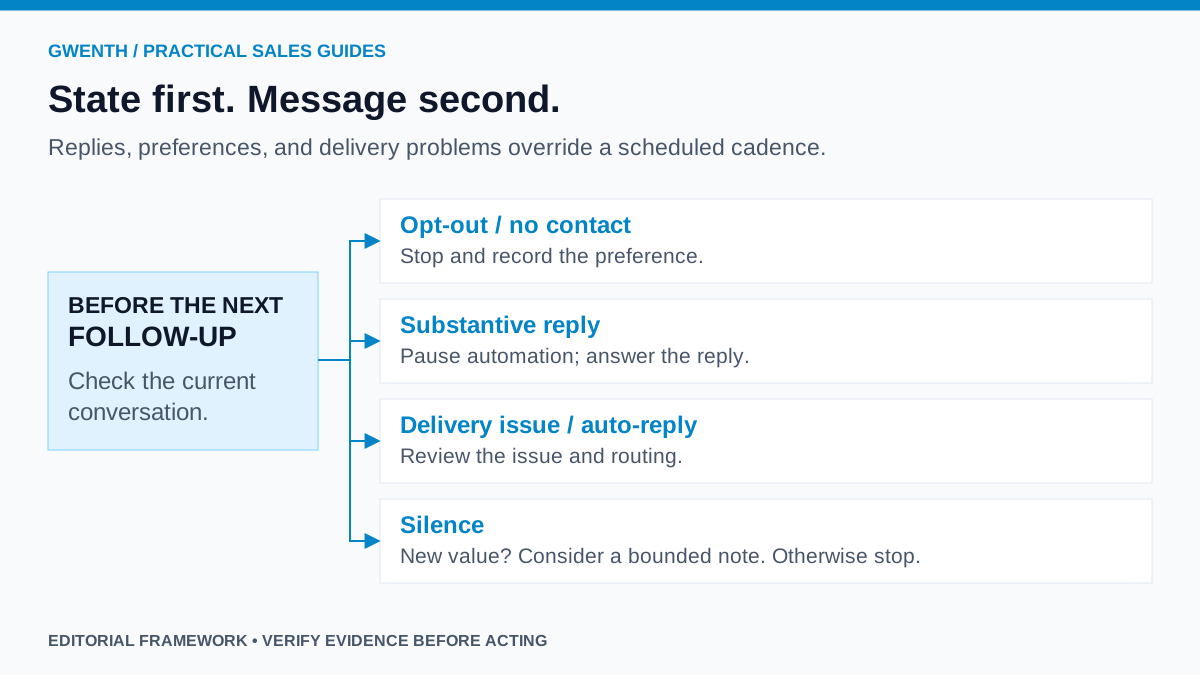
A follow-up should contribute one useful reason to continue the conversation. Use a bounded plan, preserve context, and let replies, preferences, and delivery problems override the next scheduled message.
Cold Email Follow-Up After No Response: Examples and Stop Rules
Write useful follow-ups without repeating the same pitch, and define what happens after a reply, objection, opt-out, delivery failure, or continued silence.
Scroll horizontally to inspect the diagram.
Your first email has no reply. Sending the same pitch again feels unhelpful; writing an elaborate second pitch feels disproportionate. The useful question is not how to keep the sequence alive. It is whether you have something relevant enough to justify another interruption.
Short answer
After no response, send a brief follow-up only when the original outreach remains appropriate and you can add useful context, clarify ownership, or ask an easier question. Check for replies, objections, opt-outs, and delivery problems first. Use a limited sequence and stop when you have no new relevance. Silence and tracking events are not buying intent.
Check state before writing copy
| Observed state | Recommended action |
|---|---|
| A substantive reply arrived | Pause the automated follow-up and answer what the person actually said. |
| An opt-out or no-contact request arrived | Stop the affected outreach and record the preference in the systems that could send again. |
| A bounce, complaint, or delivery problem appeared | Pause and investigate; do not retry through more addresses or channels to bypass the issue. |
| An out-of-office message arrived | Review any return date or routing information; do not mistake it for interest. |
| No reply, but a new relevant contribution exists | Consider one concise follow-up within your approved plan. |
| No reply and nothing useful to add | Close the sequence rather than manufacture urgency. |
This is an editorial operating policy, not a legal definition. Your applicable rules and recipient preferences can require stricter handling.
A bounded example cadence
Illustrative schedule, not a tested optimum: send the initial message, review after several business days, and consider one further close-the-loop note the following week. Set a maximum before the sequence begins. A small team might choose an initial message plus two follow-ups for a specific experiment; that number is a management choice, not evidence that three messages maximize replies.
Check local working hours, holidays, relevance, and contact preferences. Stop rules override dates. A buyer's response should not wait for a sequence to finish before a human notices it. Avoid restarting the same sequence under a new campaign name merely because its scheduled steps ended.
Example one: clarify who owns the workflow
Fictional example: you contacted a software company after verifying relevant sales hiring. Use the following only when that observation is accurate.
Hi Alex,
A quick follow-up on the sales-team openings I mentioned. Do you own account research and follow-up tooling for that team, or does someone else handle it?
I can send a short workflow example rather than ask you to schedule a call.
Best,
Sam
The useful contribution is a routing question and a smaller next step. Do not claim an internal introduction or a mutual connection unless one exists. Research the relevant buying role before relying on the recipient to repair an indiscriminate contact list.
Example two: add something concrete
Hi Alex,
One practical detail I left out: the workflow example separates an observed company signal from the seller's reason to act, then keeps that reason with the contact record.
Would seeing that example help, or is this not a priority for your team?
Best,
Sam
Only offer an example you can actually provide. A concrete distinction is more informative than “just checking in” followed by the same benefit claims. Keep the ask answerable. A prospect should not need to evaluate your entire product to respond.
Example three: close the loop without pressure
Hi Alex,
I'll close the loop here so I don't keep adding to your inbox. If improving this workflow becomes relevant later, you're welcome to reply to this thread.
Best,
Sam
Then stop. Do not append a countdown, guilt, or a claim that their business will fall behind. The closing note is optional; when there is no useful reason to send it, simply end the sequence. These examples show message structure, not a complete legally compliant email footer.
Do not personalize from an email open
Apple's Mail Privacy Protection documentation explains that it can prevent senders from seeing whether a message was opened. A tracking event is therefore not a dependable basis for saying “I saw you read my email”. Even a genuine open would not establish purchase interest or permission for more outreach.
Prefer information the recipient has deliberately communicated, or relevant public business evidence that you can verify. A reply asking for pricing deserves a pricing answer. A reply saying the timing is wrong deserves an appropriate acknowledgement, not the next prewritten message.
Keep technical delivery and lawful outreach separate
Google's sender guidelines set requirements for mail sent to personal Gmail accounts, including authentication and additional requirements for bulk senders. Meeting a technical requirement does not make an unwanted message appropriate, and it does not promise inbox placement.
For U.S. commercial email, the FTC's CAN-SPAM guide covers accurate sender information and subjects, advertising identification, a valid postal address, and a working opt-out. It also applies to business-to-business commercial messages. Other jurisdictions can impose different or stricter requirements; review the rules that apply to your recipients. This article is not legal advice.
Evaluate follow-up software with awkward cases
Before expanding a campaign, use controlled test contacts or consenting internal recipients to simulate a reply, an opt-out, an out-of-office message, a duplicate record, and a failed delivery. Check the planned action before and after each event. Verify whether a pause applies only to one contact, one sequence, or all relevant outreach.
Ask where the current conversation is stored and who owns it. A sequence can look correct on one screen while another campaign still contains the same person. Your acceptance criteria should cover the shared account context, not just the email composer.
How Gwenth applies this
Gwenth brings available account research, draft outreach, and reply context into a connected sales workflow. Evaluate its configured follow-up behaviour with the exact reply and preference cases your team needs; do not assume every channel or connection has identical capabilities. People still own relevance, factual claims, and the decision to continue a conversation.
The cold email drafting guide covers the initial message. This guide covers the state changes that should determine whether another message exists at all.
Common follow-up questions
Should I switch channels when email gets no response?
Not automatically. No response does not authorize escalation to a different channel. Consider the person's preferences, relationship context, platform rules, and applicable permission requirements.
What should I measure?
Track useful replies, clear disqualifications, complaints, opt-outs, and qualified next steps separately. Do not judge the sequence only by sends, opens, or a single favourable example.
Editorial note: AI assisted drafting and graphics. The messages and cadence are illustrative; no reply-rate, deliverability, meeting, or revenue outcome is promised.
Tags
References
Source material used for factual context in this article.
- CAN-SPAM Act: A Compliance Guide for Business
Federal Trade Commission · Accessed
Official U.S. commercial-email guidance on truthful sender information, subject lines, identification, postal address, opt-outs, and responsibility; not a worldwide permission rule.
- Email sender guidelines
Google · Accessed
Official sender requirements for personal Gmail recipients. Authentication and applicable unsubscribe requirements are separate from whether a recipient wants a message.
- Use Mail Privacy Protection on iPhone
Apple · Accessed
Explains how Mail Privacy Protection limits sender visibility into email opens. An open event should not be treated as evidence of purchase interest.