Reader question
What is the difference between signal-based prospecting and intent data?
Intent data and signal-based prospecting are related but not identical. Intent data can indicate research behavior, while signal-based prospecting turns observable business change into a specific outreach reason.
Signal-Based Prospecting vs. Intent Data
Intent data can suggest interest. Signal-based prospecting looks for observable business changes that create a concrete reason to reach out now.
Scroll horizontally to inspect the diagram.
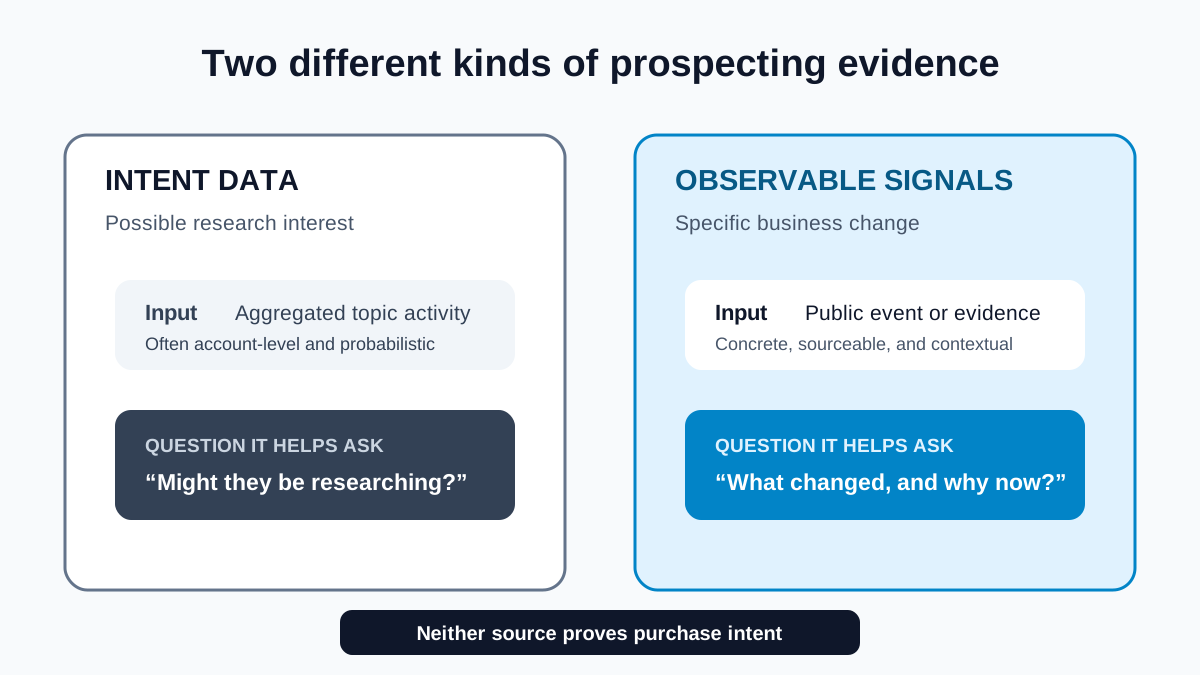
Intent data and signal-based prospecting are related, but they are not interchangeable. Intent data can suggest that people associated with an account are researching a topic. Signal-based prospecting begins with an observable change—such as a filing, hiring pattern, leadership move, product launch, or real event conversation—and asks whether that change creates a relevant reason for research or outreach. One describes possible attention; the other builds a case from evidence, context, and timing.
Short answer
Signal-based prospecting uses observable business events to decide which accounts deserve review and why now. Intent data often measures topic consumption, search behavior, or engagement associated with an account. Neither proves that a specific person wants to buy or be contacted. A responsible workflow combines fit, attributable evidence, possible intent, relationship context, and human judgment before choosing the next action.
What intent data can tell you
Intent data is a category of behavioral evidence. Depending on the provider and method, it may reflect content engagement, searches, advertising activity, website visits, or topic consumption associated with an account. It can help a team notice that interest around a subject may be rising. It usually cannot explain, by itself, who performed the activity, why they did it, whether the account fits the offer, or whether a buying process exists.
That ambiguity does not make intent useless. It makes intent one input. A researcher might use it to select an account for further investigation, compare activity over time, or test whether other evidence points in the same direction. HubSpot’s buyer-intent product documentation illustrates how the category can combine website visits, third-party research activity, company news, and contact-level changes. The variety itself is a reason to preserve source type and meaning rather than collapse every input into one conclusion.
What counts as an observable signal
An observable signal is a dated fact or interaction that may change the relevance of an account. Examples include a company’s public filing, a careers-page change, a leadership announcement, a stated expansion, a technology change, a product launch, or a conversation in which someone requested a follow-up. The signal should retain its source and exact observation. The sales hypothesis—what that fact might mean for the offer—belongs beside it, not inside it.
The SEC’s Search Filings service is one example of a primary company-disclosure source. The Bureau of Labor Statistics’ Job Openings and Labor Turnover Survey provides official market-level labor context. These sources illustrate two important boundaries: a filing may say something specific about a company, while an aggregate labor series describes a market. Neither source, without additional evidence, proves that an account is buying a product.
The five questions that turn a signal into a prospecting decision
- What was observed? Capture the fact, source, and date without rewriting it as intent.
- Does the account fit? Confirm that the company and plausible buyer fall inside the team’s documented market.
- Why might it matter now? State the hypothesis connecting the observation to a problem the team can genuinely help with.
- What contradicts the hypothesis? Look for stale dates, unrelated roles, duplicate reports, existing relationships, exclusions, or explicit preferences.
- What is the smallest responsible next action? Choose research, monitoring, preparation, a relevant follow-up, or disqualification—not outreach by default.
This framework turns a “signal” from a reason to send into a reason to think. It also makes weak evidence easy to reject. If a change is real but unrelated to the offer, the correct result is no action. If intent activity is strong but the account is outside the market, the correct result may also be no action.
How the message changes
A message based only on generic topic activity can sound intrusive or vague: “I saw your company may be interested in automation.” A signal-based approach first verifies whether a public change is accurate and relevant. If contact is appropriate, the message can identify the source plainly, explain why the sender thought it might matter, and leave room for correction. It should never imply private knowledge, a prior conversation, or purchase intent that the evidence does not establish.
For example, a careers page might show several newly posted implementation roles across two countries. The observation is the postings and their dates. The hypothesis is that the team may be managing expansion complexity. A researcher should verify that the roles are current, identify whether the offer actually relates to that work, check relationship and preference records, and decide whether a useful next step exists. The postings are not consent and are not proof of budget.
Vertical context changes signal meaning
The same observation can matter differently across markets. Hiring could imply workforce coordination for an HR software team, implementation capacity for a services firm, or security coverage for a cybersecurity vendor. A vertical thesis names the operational mechanism rather than attaching generic urgency to every change. It also specifies negative evidence: which roles are unrelated, which geographies are unsupported, and which account types should be excluded.
That is why a useful signal library is not merely a catalog of events. Each signal needs a source class, recency rule, relevance hypothesis, confidence limit, and review path. Vertical signal intelligence makes those interpretations explicit enough for a seller to challenge.
Common mistakes
- Treating account activity as person-level intent: an account association does not identify a specific researcher or buyer.
- Double-counting reports: several articles repeating one announcement are one underlying event, not independent confirmation.
- Using recency as relevance: a new fact can still be unrelated to the offer.
- Turning a score into permission: prioritization does not establish consent, channel suitability, or a welcome message.
- Removing the source during handoff: sellers need to see what was observed and how the interpretation was formed.
How Gwenth applies this
Gwenth can organize available account and signal context around a team’s chosen market thesis, preserve source provenance, and support prioritization and review. Depending on connected sources and user configuration, that context can inform email or LinkedIn workflow drafts, unified reply handling, meeting preparation, CRM/account records, and next-action support. A Gwenth record should help a user see what changed and why it was considered relevant; it does not prove intent, permission, data completeness, deliverability, or an eventual sales outcome. Users remain responsible for verification and action approval.
A practical operating rhythm
Review new observations on a consistent schedule. Deduplicate the underlying event, separate fact from hypothesis, compare it with fit and relationship context, and route uncertain items to research. Let sellers record whether the interpretation was useful, incorrect, stale, or disqualified. Over time, those outcomes improve the team’s rules without converting the model into a promise.
Read next: use buying-window intelligence to connect timing evidence with account fit and a reviewable next step.
Tags
References
Source material used for factual context in this article.
- Buyer Intent Data Software
HubSpot · Accessed
Authoritative vendor documentation showing that buyer-intent products can combine website, research, company-news, and contact-level signals.
- Search Filings
U.S. Securities and Exchange Commission · Accessed
Provides a primary public source for company disclosures that researchers can inspect, date, and interpret cautiously.
- Job Openings and Labor Turnover Survey
U.S. Bureau of Labor Statistics · Accessed
Provides official labor-market context while illustrating why aggregate trends do not establish account-level purchase intent.