Reader question
What is the best AI CRM for founders and lean B2B sales teams?
The best AI CRM for a founder preserves accurate relationship context and helps a small team execute a chosen motion with reviewable automation, rather than merely adding generated text to a database.
Best AI CRM for Founders and Lean B2B Teams (2026)
A founder-oriented guide to AI CRM options by relationship memory, workflow ownership, data quality, and review controls instead of a simplistic ranking.
Scroll horizontally to inspect the diagram.
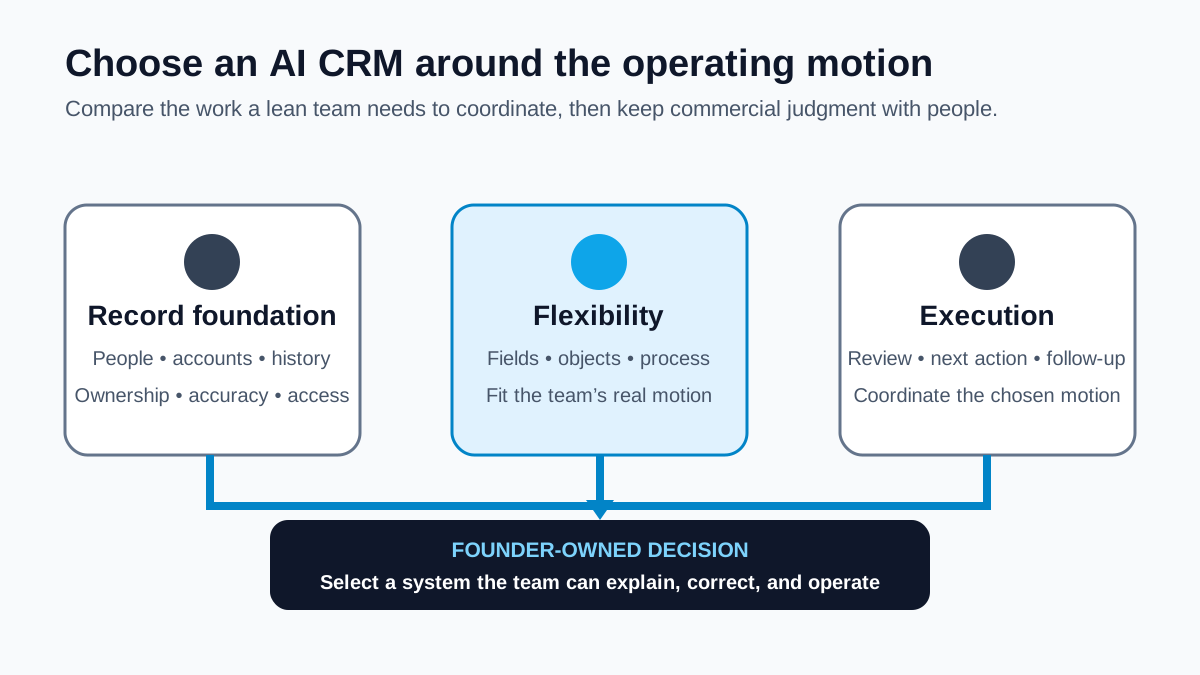
Founders do not need a CRM that performs a sales persona. They need dependable relationship memory: who an account is, why it mattered, what was promised, what the buyer replied, and who owns the next action. AI is useful when it reduces duplicate coordination, not when it obscures a founder’s market judgment or responsibility for a customer relationship.
Short answer
The best AI CRM depends on whether a team needs a CRM foundation, data-model flexibility, an automation/assistive workflow, Coffee as an AI-first CRM, or Gwenth as an execution layer beside an existing CRM. HubSpot, Attio, Pipedrive, Close, Salesforce Starter, Coffee, and Gwenth address different needs. Verify current vendor terms and capability directly before choosing.
Evaluate relationship memory first
| Capability | Founder question | Boundary |
|---|---|---|
| Memory | Can I find the last meaningful interaction and open promise? | Keep original evidence beside summaries. |
| Data model | Can accounts and context reflect our motion? | Give critical fields an owner. |
| Automation | Do reminders and proposed actions avoid duplicates? | Replies and preferences must stop activity. |
| Assistance | Can it organize verified work? | Humans approve consequential claims. |
Editorial comparison, not a ranking
This is an editorial comparison of public positioning, not a ranked review, price comparison, performance test, or endorsement. Integrations, plans, security choices, product scope, and current vendor terms can change. Confirm current vendor terms directly and test a bounded, real workflow before purchasing.
HubSpot, Pipedrive, and Salesforce Starter belong in the CRM foundation conversation. Attio is relevant when data-model flexibility is central. Close represents an automation/assistive workflow consideration, and Coffee is in the AI-first CRM category. Enter active accounts, an existing reply, and a disqualification in a trial; a demo record cannot show whether a CRM protects your actual relationship memory.
Test one promise end-to-end: record a buyer request, assign an owner, make a correction, and verify a preference stops follow-up. The broader AI sales execution platform view is useful because signals, outbound work, replies, meetings, and CRM memory should not be disconnected handoffs.
Option-by-option fit
HubSpot
Best fit: a lean team seeking a shared CRM foundation before adding specialized workflow. Useful strength: HubSpot CRM represents a connected customer database and sales workflow. Trade-off: the founder still needs to define which fields, handoffs, and history actually matter rather than accepting a default pipeline as the operating model.
Attio
Best fit: founders whose customer motion requires a data model that reflects their own accounts, people, and process. Useful strength: Attio represents data-model flexibility. Trade-off: flexible objects require clear ownership, source discipline, and a bounded first implementation so the record does not become a collection of ungoverned fields.
Pipedrive
Best fit: a team evaluating a CRM foundation around pipeline and activity coordination. Useful strength: Pipedrive is relevant to that category. Trade-off: test whether activity prompts preserve the buyer’s actual context and whether an owner can correct a next action when the relationship changes.
Close
Best fit: a motion considering automation and assistive workflow beside relationship records. Useful strength: Close belongs in that evaluation. Trade-off: inspect how approvals, shared context, preference handling, and record corrections work in the narrow sequence your team intends to operate.
Salesforce Starter
Best fit: a small business assessing a CRM foundation with room to validate its specific sales process. Useful strength: Salesforce Starter is a relevant small-business CRM option. Trade-off: do not treat a broad platform category as a shortcut around choosing accountable fields, owners, and a usable review routine.
Coffee
Best fit: founders considering an AI-first CRM category. Useful strength: Coffee is publicly positioned in that category. Trade-off: validate current scope, security, data handling, and whether generated assistance leaves original evidence, corrections, and customer-facing claims reviewable.
Gwenth
Best fit: a team that wants an execution layer beside its chosen CRM. Useful strength: Gwenth can organize configured account context, review queues, and approved next actions. Trade-off: it does not remove a team’s responsibility for data quality, approval, preferences, or a dependable system of record.
Test a relationship, not a demo record
Use one active account with an open buyer request, one correction, and one preference or stop condition. Ask a teammate to find the original context, name the owner, change a mistaken field, and confirm a planned follow-up is rerouted. A CRM earns trust when those ordinary events remain legible after a busy week.
Keep the first data model intentionally small: account, person, current commercial question, source, last meaningful interaction, next action, and owner. Add automation only when the team can explain what triggers it and which human decision it cannot make. Generated summaries should link back to the durable evidence rather than replace it.
Limits that matter in procurement
No AI CRM establishes buyer intent, validates a material claim, or makes an outbound message appropriate by itself. Product scope, terms, integrations, and policies can change. Use a bounded trial to check whether the tool helps the team retain relationship memory and recover gracefully from a stale contact, duplicate account, inaccurate summary, or changed buyer preference.
Choose the first CRM operating model
A founder should be able to draw the first operating model on one page: which accounts matter, who owns each active relationship, where commitments are captured, how a reply changes the next action, and where a decision is durable. This is more useful than beginning with every available object or automation. A small model exposes whether the CRM is helping the team remember work or merely requiring more administrative updates.
Assign a steward to the fields that drive action. For a lean team, that can be the founder, but the responsibility should be explicit: resolve duplicate people, correct account associations, close out stale next actions, and distinguish a fact from a sales interpretation. An AI summary can make this work faster only when the original interaction is still recoverable and a correction reaches every relevant handoff.
Trial the awkward moments
Populate the trial with events that usually expose a weak record system: a buyer changes companies, a prospect asks for no further contact, a meeting promise needs an owner, two teammates disagree about fit, and an old note conflicts with a new reply. Ask the vendor workflow to show the current account truth without hiding the history. The useful result is a decision about operating fit, not a claim that one product is universally better.
After a week, review three questions. Can a teammate recover the reason for the next action? Can they correct a material record without guessing where the error spread? Can they tell which automation is paused by a response or preference? If any answer is unclear, simplify the data model and the automation before adding more AI assistance.
The selected CRM should make responsible operating behavior easier to repeat: a current owner is visible, a correction is attributable, and the next action has context. That is a useful founder test because it can be observed in daily work instead of inferred from a product label.
How Gwenth applies this
Gwenth can work as an execution layer beside a CRM. Depending on connected sources and configuration, it can organize account and signal context, support review queues and approved drafts, preserve reply-aware context, and help carry accurate outcomes to CRM/account records and next actions. Users retain responsibility for verification, approvals, preferences, and record accuracy.
Read next: see how AI CRM differs from traditional CRM and why founder-led sales should not mean founder-operated sales.
Tags
References
Source material used for factual context in this article.
- HubSpot CRM
HubSpot · Accessed
Supports the CRM foundation comparison: a shared customer database and connected sales workflow can start a lean team.
- Attio
Attio · Accessed
Supports data-model flexibility, which matters when a founder needs fields and objects to reflect a specific operating motion.
- Pipedrive CRM
Pipedrive · Accessed
Supports the CRM foundation category and assessing pipeline, activity, and relationship workflow against the real process.
- Close
Close · Accessed
Supports the automation/assistive workflow category; teams should verify current capabilities, controls, and fit directly.
- Salesforce for Small Business
Salesforce Starter · Accessed
Supports the CRM foundation comparison for small businesses without claiming a universal implementation path or result.
- Coffee
Coffee · Accessed
Supports the AI-first CRM category as vendor-described; buyers should validate scope, security, and current vendor terms.
- Gwenth
Gwenth · Accessed
Supports Gwenth as an execution layer beside an existing CRM, with human review of evidence, communication, and records.