Reader question
How can I find B2B companies that are hiring or expanding?
Start with the business change that could make your offer relevant, verify it against an attributable source, and separate an observed event from your hypothesis about a buying need.
How to Find B2B Companies That Are Hiring or Expanding
A practical prospecting workflow for finding hiring and expansion evidence, checking its relevance, and turning it into a defensible account shortlist.
Scroll horizontally to inspect the diagram.
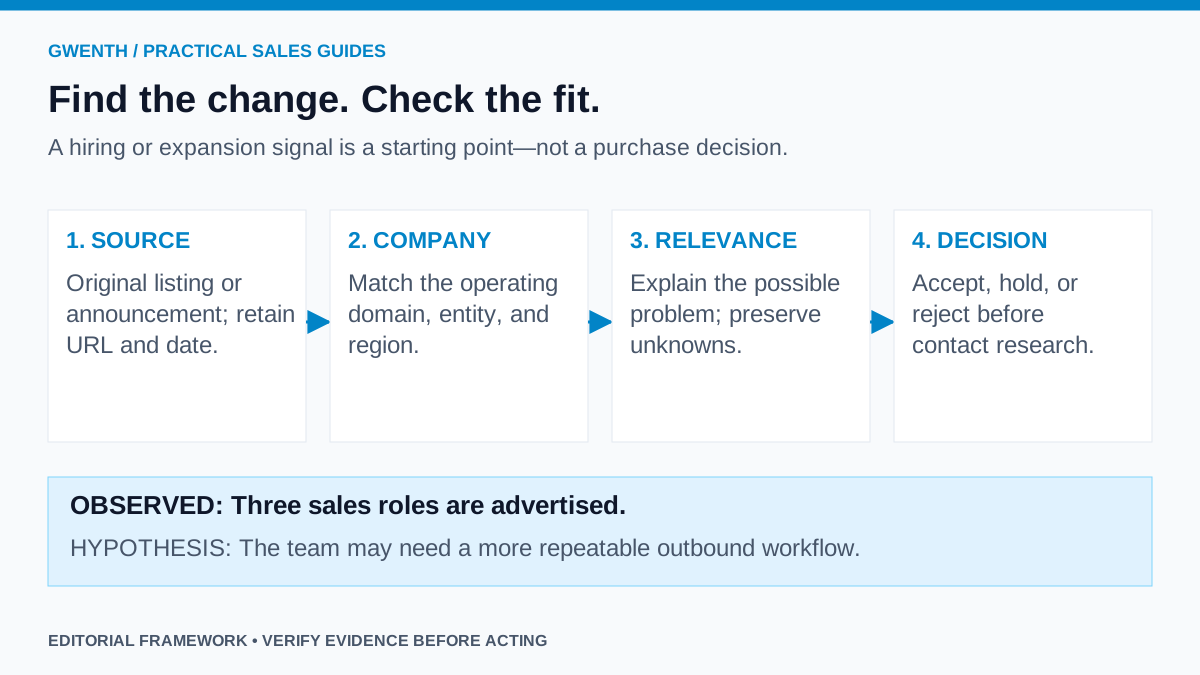
A company posts three sales vacancies. Another announces a new regional office. A third raises funding. All three are easy to put in a spreadsheet; none automatically belongs in your pipeline. The important question is which change creates a plausible reason to investigate your particular offer.
Short answer
Find hiring and expanding B2B companies by monitoring relevant job searches, company career pages, company announcements, and public filings where available. Save the exact source, event date, company domain, and observation. Then check account fit, distinguish new growth from replacement hiring, and identify who owns the possible problem before deciding whether to contact anyone.
Define the change you are looking for
Begin with a hypothesis that connects an observable event to a problem you can actually solve. For recruiting services, several open engineering roles might justify investigating hiring capacity. For sales software, a new outbound team might justify investigating account research and follow-up coordination. An office opening could matter to an IT provider but be irrelevant to a product that serves an entirely different function.
Write your rule before searching: “We investigate companies in this segment when this type of change appears, because it may introduce this workflow problem.” Include an exclusion. A customer-success vacancy should not qualify an account for an engineering-recruitment campaign simply because both involve hiring.
Use a source ladder
| Source | Useful observation | What remains uncertain |
|---|---|---|
| Company career page | A named role is publicly advertised at the time checked. | Whether it is new headcount, approved, filled, or a replacement. |
| Job-search alert | A listing matches your saved criteria. | Whether a repost or agency listing duplicates the original. |
| Company announcement | The company describes a launch, office, investment, or expansion. | Whether the plan has started and creates demand for your service. |
| Public-company filing | An attributable disclosure documents a business change or risk. | Whether the statement applies to the subsidiary or region you target. |
LinkedIn documents daily and weekly job alerts. Use a narrow role and geography rather than collecting every vacancy. For relevant public companies, SEC EDGAR search provides a route to official filings. These are complementary research sources, not exhaustive coverage of the private-company market.
Run a repeatable search
Choose one segment and a manageable company list. Search by a role family, region, and company context; then open the employer's original page when available. Example search strings such as "sales development" "careers" "Singapore" or "opens new office" "software" are starting points, not promises of comprehensive results. Replace the terms with the language your target companies use.
Check the company website's news and careers sections together. A new office announcement and vacancies in that same location are different observations; record them separately before interpreting their relationship. Do not count several syndications of one press release as independent corroboration.
Store both the event date and the date you checked it. When a listing has no publication date, label that unknown instead of using today's date as the hiring date. A six-month-old announcement discovered today is not a new expansion event.
Separate observed evidence from sales interpretation
A useful account record has two distinct sentences. The first says what the source shows. The second explains the possible commercial relevance. “The employer advertises three outbound sales roles” is an observation. “The team may need a more repeatable prospecting workflow” is a hypothesis. “They need our product now” is an unsupported conclusion.
Use the company's operating domain to resolve identity. A similarly named business, subsidiary, franchise, or recruitment agency may not be the account you intended. Keep the source associated with the entity it actually describes, rather than automatically assigning a parent's announcement to every subsidiary.
A worked example
Fictional, illustrative example: Northstar Analytics is a small software vendor on your target list. Its careers page advertises two sales-development roles and one account-executive role for a new regional team. You sell a workflow for organizing prospect research and follow-up.
Your observation is the three advertised roles, with their URLs and dates. Your relevance hypothesis is that a growing outbound team may need consistent account context. Your unknowns are whether the roles are incremental, whether the team already has a suitable workflow, and who owns the project. Your next action is to research the sales or operations owner, not immediately enrol everyone in a campaign.
A useful opener would be: “I saw the two sales-development openings on your careers page. Are you building a new outbound motion, or expanding an existing one?” It asks a grounded question without asserting that you know the company's internal priorities.
Reject weak signals deliberately
Hold or reject accounts when the vacancy is stale, the company match is unclear, the role does not fit your offer, or the announcement describes a plan with no relevant execution evidence. Keep the rejection reason. Otherwise, the same bad account can re-enter the list every time someone rediscovers its announcement.
Do not infer budget from funding alone. Do not claim an advertised role proves headcount growth. Do not claim that several observations prove purchase intent. The buying-signal scorecard is a review framework, not a probability that someone will buy.
Choose tools after proving the workflow
A saved search and a small review sheet can establish whether your rule finds useful accounts. When manual monitoring becomes the bottleneck, compare tools on source coverage, date visibility, duplicate handling, and the ability to inspect the evidence. Clay's Custom Signals documentation, for example, describes configured monitoring of websites and other sources. That documents a capability, not the quality of your eventual account list.
Measure accepted, held, and rejected observations before measuring message volume. A useful weekly review asks which sources produced relevant accounts, which repeated stale evidence, and how many accepted accounts had a credible contact. The buying-signal software comparison helps separate monitoring, intent-data inputs, and execution support.
How Gwenth applies this
Gwenth can organize available account and signal context for review and connect that context with subsequent outreach work. The useful evaluation is whether your team can inspect why an account appeared, correct a poor match, and preserve the reason for its next action. Coverage and exact behaviour depend on connected sources and configuration; no source list guarantees buying intent or a commercial result.
Next, use the decision-maker research guide to identify a relevant person. That is a separate decision from establishing company fit.
Common questions
Does every hiring company count as a lead?
No. The role, company, location, and possible problem must fit your offer. Hiring is evidence to interpret, not an automatic qualification.
How many signals should I require?
There is no threshold established by this guide. One clear, relevant source can be more useful than several duplicate or weak ones. Record uncertainty rather than inflating confidence through counts.
Editorial note: AI assisted drafting and graphics. The workflow and fictional example are Gwenth editorial guidance, not a customer case study or a tested conversion claim.
Tags
References
Source material used for factual context in this article.
- Manage job alerts
LinkedIn · Accessed
Documents saved job alerts and daily or weekly notifications; a job posting does not establish a completed hire or purchasing intent.
- Search Filings
U.S. Securities and Exchange Commission · Accessed
Official discovery route for public-company filings, which can support research into disclosed changes but does not cover every private business.
- Custom Signals
Clay · Accessed
Documents configured monitoring of sources and business changes; used as a product example, not independent evidence of conversion benefits.