Reader question
How should a founder evaluate an AI CRM before adopting it?
Choose an AI CRM by testing the work your team must reliably complete: accurate records, recoverable context, clear ownership, controlled follow-up, and usable data when something changes.
AI CRM Evaluation Checklist for Founders and Lean B2B Teams
A practical AI CRM trial checklist: test company and contact accuracy, relationship history, reply handling, permissions, export, and the real cost of your workflow.
Scroll horizontally to inspect the diagram.
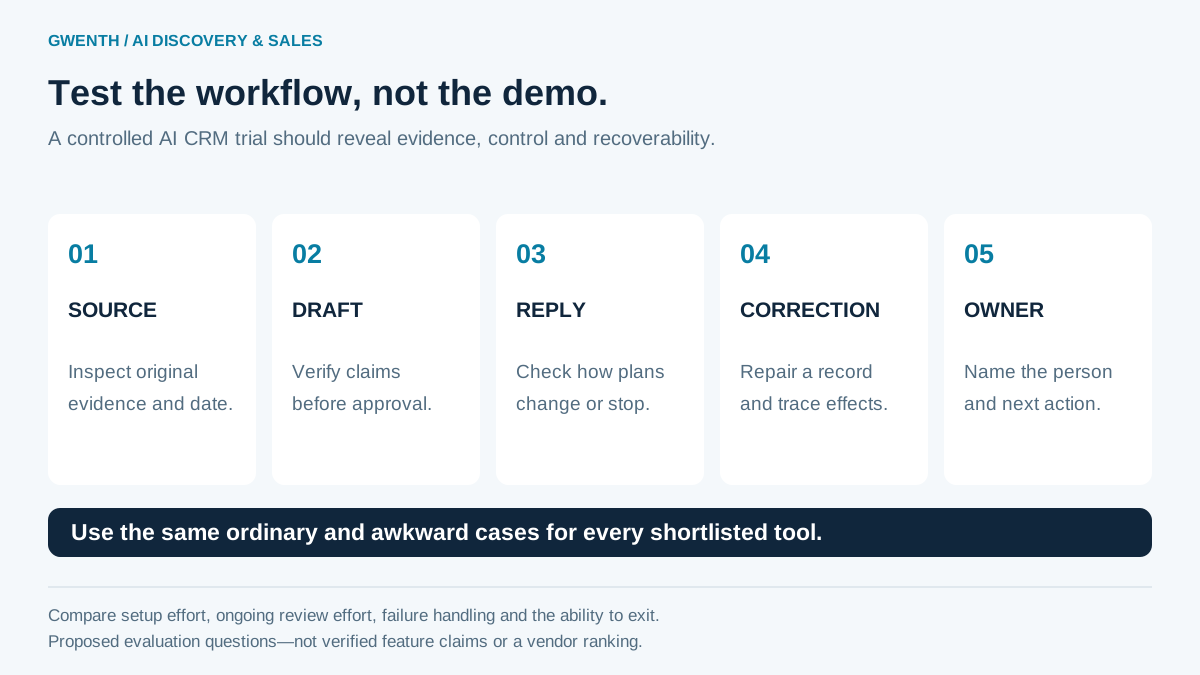
A CRM demo usually starts with a clean record, a polished pipeline, and a fast AI summary. Your working week contains duplicate contacts, half-complete notes, a buyer who changed employers, and a follow-up that should have stopped. Evaluate the system against that week, not only against the demo.
Short answer
Evaluate an AI CRM by running a small, controlled set of real workflow tests. Check identity and company associations, original evidence behind summaries, ownership of next actions, reply and preference handling, permissions, export, and total operating cost. Score each requirement as demonstrated, not demonstrated, or failed. An AI label or generated recommendation is not evidence of product fit.
Define the job before selecting the product
Write down the first workflow the CRM must support. For a founder, that might be researching an account, recording why it matters, identifying a relevant person, approving an outreach message, responding to a reply, and assigning the next action. Another team might primarily need a deal board or a calling workflow. These are different briefs.
List the tools you intend to retain. A replacement CRM, an execution layer beside an existing CRM, and a specialist data provider solve different problems. The founder CRM comparison provides the category distinctions; this checklist supplies the trial.
Prepare a small trial dataset
Use fictional records, authorized sample data, or consenting internal recipients. Include a prospective company, an existing customer, a similarly named company, two relevant people at one account, a duplicate contact, and an outdated job title. Add one source-backed research note and one explicitly uncertain interpretation.
Do not upload sensitive customer material merely to make a demo realistic. Agree the permitted data, access, retention, and deletion arrangements first. Record who owns the trial and which external actions are allowed. A test of draft creation should not silently become a live email campaign.
The acceptance checklist
| Test | Action | What a pass should show |
|---|---|---|
| Company identity | Create similarly named companies with distinct domains. | Records remain separate; research is attached to the correct entity. |
| Multiple contacts | Add an operational owner and a budget-owner hypothesis. | Both belong to the account, with distinct roles and uncertainty visible. |
| Duplicate correction | Introduce and reconcile a duplicate. | The required history survives without creating parallel planned outreach. |
| Evidence and summary | Generate or review a summary containing one ambiguous note. | The original context remains recoverable; uncertainty is not rewritten as fact. |
| Next-action ownership | Record a buyer request and assign a follow-up. | An accountable person, due date, and reason are visible. |
| Reply handling | Send a controlled reply before a pending follow-up. | The configured stop or review policy applies before the next send. |
| Contact preference | Record a no-contact request. | Every relevant sending path in the agreed scope respects that preference. |
| Access and export | Test a restricted user and export the agreed records. | Access matches policy and exported data contains the relationships you need. |
These are proposed acceptance criteria, not a claim that every named product supports each one. Mark a feature “not demonstrated” when the vendor has not shown it. Do not upgrade that result to “passed” because a roadmap mentions it.
Inspect the relationship model
HubSpot documents activity associations and exceptions across contacts, companies, and deals. Attio documents object records, relationships, and list-specific attributes. Those examples illustrate why a contact history and a workflow state are not interchangeable.
In your trial, change a person's employer and inspect old and new account history. Put one company into two workflows and change only one workflow's next action. The expected result should be specified by your team: which facts are shared, which belong only to that workflow, and who can correct them?
Test what happens after a reply
Close's Workflow Goals documentation describes configured events that can stop a workflow run. The general lesson is to test the setting and scope, not assume that “automation” means every planned action reacts correctly.
Use one substantive reply, one automatic reply, and one opt-out. Check the contact, account, active workflow, and other planned outreach in the agreed scope. Ask what happens when a provider disconnects or a reply arrives shortly before a scheduled send. Record observed behaviour separately from the vendor's explanation.
A fictional founder trial
Imagine a two-person software company evaluating a CRM for outbound work. The founder records a hiring signal for a target account. A teammate adds a relevant operations contact. The AI summary incorrectly describes the hiring signal as a confirmed procurement project.
The trial should reveal whether the teammate can locate the original source, correct the interpretation, and ensure the next draft no longer repeats the mistake. Then a controlled recipient replies that the project belongs to another person. The next action should be reviewed and the ownership note updated, rather than allowing the original sequence to continue unquestioned.
This fictional example tests recoverability and coordination. It is not a report of a defect in a named vendor or a claim about Gwenth performance.
Compare total operating cost
Ask which costs depend on seats, enrichment, AI usage, email or calling activity, storage, required integrations, and implementation. Separate subscription cost from setup and ongoing administration. Use your expected workload with a clearly labelled assumption for each variable.
For example, compare a low subscription that requires substantial weekly manual coordination with a broader product that duplicates tools you already pay for. Neither is automatically cheaper in your workflow. Obtain current terms directly and avoid turning a short demo into a long commitment before the required tests pass.
How Gwenth applies this
Gwenth is designed to connect available account research, signal context, outreach work, replies, and follow-up for founders and lean B2B teams. Bring this checklist to an evaluation and ask for the specific workflow you need. Coverage, connections, approval modes, and exact automation behaviour depend on the configured setup.
Gwenth may not be the right first choice when you only need a basic contact list, a specialized calling platform, or a deeply customized enterprise system of record. It is worth comparing when disconnected research and execution are the problem. A product discussion should establish the fit rather than assume it.
Make a decision from observed work
Keep a short record of each test: requirement, input, observed result, evidence, owner, and unresolved issue. Decide in advance which failures block adoption. If a required integration or data export has not been demonstrated, leave the decision open instead of averaging that gap into a reassuring overall score.
Do I need the most powerful AI model?
This checklist does not establish a model ranking. Accurate relationships, usable context, and controlled actions are the acceptance criteria; evaluate any AI assistance against them.
Can I start without a full migration?
Consider a bounded trial or an execution layer beside your current system where supported. Confirm the actual connection and ownership of records rather than assuming two products integrate.
Editorial note: AI assisted drafting and graphics. This is an evaluation framework with a fictional example, not a hands-on vendor benchmark, customer testimonial, or promise of commercial results.
Tags
References
Source material used for factual context in this article.
- Associate activities with records
HubSpot · Accessed
Shows why relationship-history association is a concrete acceptance test: automatic and manual linking have documented conditions and exceptions.
- Define your data model: objects, lists, and views
Attio · Accessed
Provides a documented example of separating object records, relationships, and workflow-specific list data in CRM evaluation.
- Workflows
Close · Accessed
Documents triggers, steps, runs, and Workflow Goals. Supports testing the configured stopping behaviour rather than assuming it from a product label.