Reader question
What content should a B2B SaaS company publish for useful AI discovery?
Publish pages that resolve distinct buyer decisions with concrete evidence. Use consistent product identity, readable comparisons and linked methods while avoiding duplicate briefs, fabricated proof and unsupported promises of AI visibility.
B2B SaaS Content for AI Search: A Buyer-Question Matrix
Plan distinct, evidence-backed pages around category fit, integrations, comparisons and implementation—not repeated versions of the same keyword.
Scroll horizontally to inspect the diagram.
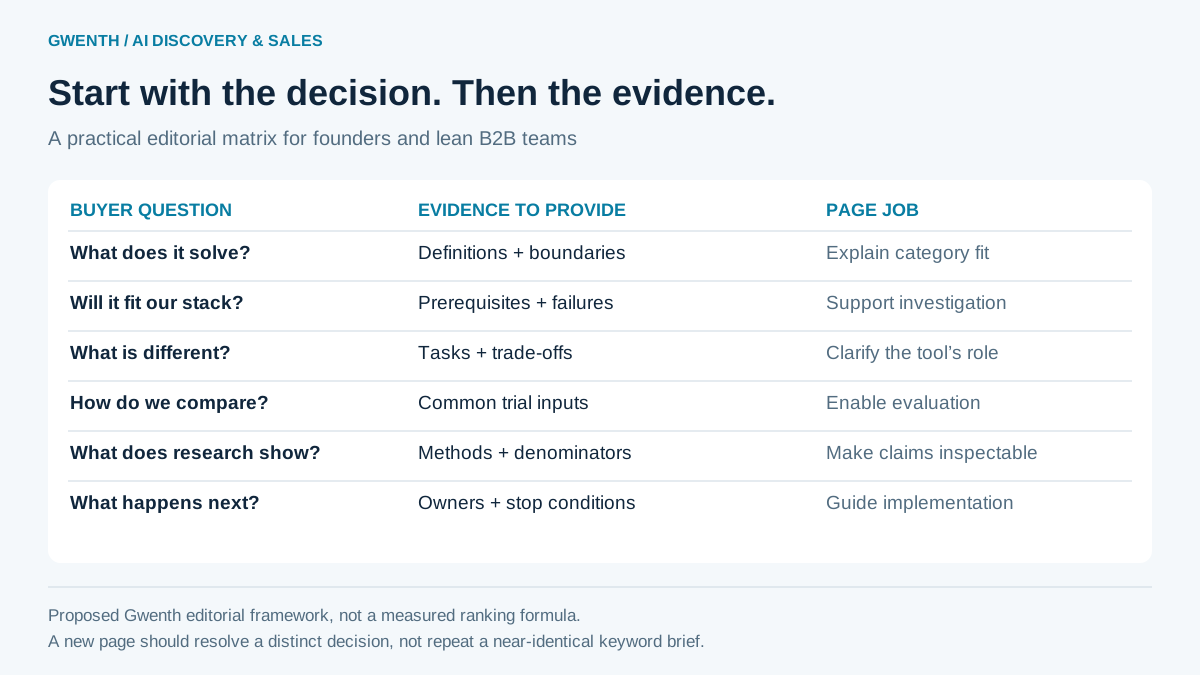
“Write more content for AI” is not a sufficiently precise brief. A small software company can quickly produce ten articles that all repeat its positioning, without helping a buyer resolve a single additional question.
A more useful unit is the decision. What must someone understand before deciding whether to investigate the product, compare it with an alternative, or trust it with a real workflow? The following matrix is Gwenth editorial guidance for building that kind of content.
Short answer
Build a compact content cluster around different buyer decisions: category fit, workflow fit, integration requirements, alternatives, evaluation and implementation. Give each page its own evidence and next step. Use original research where relevant, but do not imply that publishing more pages, adding keywords or following a template ensures AI inclusion.
A content matrix a founder can actually use
| Buyer question | Evidence to provide | Useful output |
|---|---|---|
| What problem does this solve? | Definitions, boundaries and a worked workflow. | Category explainer. |
| Will this work with our stack? | Verified connections, prerequisites and failure cases. | Integration guide. |
| How is it different? | Specific tasks, ownership and trade-offs. | Role comparison. |
| How do we evaluate options? | Comparable trial inputs and acceptance criteria. | Buyer checklist. |
| What does the research show? | Methods, denominators and limitations. | Research explainer. |
| What happens after we start? | Setup steps, review responsibilities and stop conditions. | Implementation playbook. |
Before commissioning a page, complete all three columns. If the evidence column contains only marketing adjectives, the page is not ready. If two pages have the same question and same evidence, merge their briefs or explain the genuinely different decision each will resolve.
Make horizontal needs and vertical contexts explicit
ARCADE’s CRM study separates product priorities—affordability, security/reliability and integration—from industry contexts—cybersecurity, financial services and recruitment. That distinction gives an editorial planner a useful question: are we explaining a product requirement, or how that requirement plays out in a particular workflow?
Do not manufacture six near-identical industry pages by changing the industry name. A recruitment guide needs a genuinely relevant example and an honest boundary around candidate versus client workflows. A cybersecurity guide needs evidence appropriate to that sales context. These are proposed briefing standards, not findings that those industries require your product.
For Gwenth, start from the actual sales work the product is intended to support. Where a vertical capability is not established, explain a general evaluation method rather than implying a bespoke integration, regulatory approval or specialised data source exists.
Four useful sales-software briefs
AI SDR versus CRM versus sales execution
Explain which system stores relationship history, which prepares outreach and which coordinates next actions. Use a fictional account to show handoffs and possible duplication. Link the comparison to the sales execution category explainer rather than presenting every tool as a direct replacement for every other tool.
Buying signals versus intent data
Show the original observation, the interpretation and the seller’s remaining decision. A company announcement is not the same thing as verified buying intent. The existing signal-versus-intent article provides a place to go deeper without repeating its entire argument in a second page.
Event follow-up without losing context
Use an accurately labelled scenario: how a real conversation note becomes a reviewed follow-up and a durable next action. Distinguish people you spoke with from people merely appearing on a list. Connect to the event follow-up playbook rather than promising access to an attendee database.
How to evaluate an AI CRM
Give buyers a trial they can run: a source, a draft, a reply, a correction and an accountable owner. The AI CRM evaluation checklist is a distinct bottom-of-funnel page because it helps someone test fit instead of merely defining a category.
Use a page contract, not a word-count target
A useful page contract contains the primary reader question, a direct answer, one central example, a decision table where appropriate, source notes, limitations and a relevant next step. The answer should make sense without forcing the reader through every page in the cluster.
Google explicitly says it has no preferred word count. Its guidance also asks whether a page adds value beyond rewriting other sources. Our editorial rule is therefore to stop when the decision is adequately explained, and to expand only when an unanswered objection or missing piece of evidence justifies it.
For a factual claim, place the source near the claim and state what it supports. Do not use a standards document as proof that your product is certified, or a vendor’s marketing page as independent evidence of performance. Keep dates meaningful: update the page when the substance changes, not merely to display a newer timestamp.
Make diagrams carry explanatory work
Choose a graphic according to the reader’s problem. Use a process diagram for a sequence, a matrix for different decision dimensions and a chart for quantitative findings. Label illustrative content as illustrative. A chart should name its scale, population, units and exclusions.
For example, an ARCADE repeat-overlap graphic needs a zero-to-one similarity scale and the denominator caveat for citationless pairs. A fictional follow-up diagram needs a clear approval or stop decision. Decorative icons alone do not resolve either problem.
Google’s AI-feature guidance recommends keeping important information in text and matching structured data to visible content. In our page design, the diagram supplements the explanation; it is not the only place a result, prerequisite or limitation appears.
Link by the next decision
An internal link should answer “what would this reader need next?” A category explainer can lead to an evaluation checklist. A research article can lead to its methods and a measurement protocol. An implementation article can lead to a bounded product discussion.
Avoid making every paragraph link to the same sales page. Equally, do not leave a useful research article disconnected from the product context it helps explain. Use descriptive anchors that identify the destination rather than making a vague promise.
How Gwenth applies this
Gwenth can organise its editorial work around the seller’s decisions: identify a relevant account, inspect available context, review an outreach draft, understand a reply and retain the next action. Product claims should remain tied to verified configuration and source availability, with a clear distinction between what the platform supports and what the seller decides.
This cluster connects research to those questions without presenting Gwenth as an AI visibility monitoring service. Its purpose is to make the product and the research easier to evaluate. Subsequent visibility and business effects still need measurement.
Content planning questions
Should we write an article for every paraphrase?
Not by default. ARCADE tests wording sensitivity, but it does not show that publishing near-duplicate pages is an effective response. Cover closely related wording naturally when it expresses the same decision.
Can AI assist the writing?
Yes, with accountable editorial decisions and accurate disclosures. In this series AI assisted drafting and graphics; research caveats and proposed examples remain visible rather than being converted into unsupported success claims.
Tags
References
Source material used for factual context in this article.
- ARCADE: September 2026 CRM discovery findings and methods
ARCADE / Gwenth · Accessed
First-party aggregate extract from the 22 September analysis of 216 selected AI answers and 54 Google snapshots. Model-assisted labels; human semantic validation remains incomplete. This is not independent validation of Gwenth.
- Creating helpful, reliable, people-first content
Google Search Central · Accessed
Supports original, useful, clearly attributed content and accurate authorship disclosures. It is guidance, not evidence that a particular article format guarantees citation.
- AI features and your website
Google Search Central · Accessed
Official Google-only eligibility and reporting guidance; not a ranking recipe for other AI platforms.