Reader question
How should a B2B SaaS company approach generative engine optimization?
A defensible GEO programme starts with a buyer problem, makes product evidence accessible, and tests visibility across repeated questions. It does not begin with a promise to control an AI shortlist.
GEO for B2B SaaS: An Evidence-First Playbook
Build useful, source-backed SaaS content and measure AI discovery across buyer needs, platforms, wordings and repeated answers.
Scroll horizontally to inspect the diagram.
A founder asks an AI assistant which tools could help a small sales team. A competitor appears. The founder asks again, changes a few words, and now a different shortlist appears. Which answer should determine the content budget?
The useful response is not to chase one favourable screenshot. It is to define the buyer situation, improve the evidence that explains your product, and keep a record of how discovery behaves. This guide proposes that operating approach for founders and lean B2B software teams.
Short answer
GEO for B2B SaaS is the practice of improving how clearly a software business can be discovered, understood and represented in AI-generated answers. Start with specific buyer questions, publish factual answers with attributable evidence, preserve ordinary search accessibility, and measure mentions, citations and recommendations separately. No content format ensures inclusion.
What the research actually establishes
The original GEO research introduced a framework and benchmark for studying visibility in generative answers. Its reported improvements depended on the experimental setting and domain. Treat that as a reason to test content interventions, not a forecast of an uplift for your website.
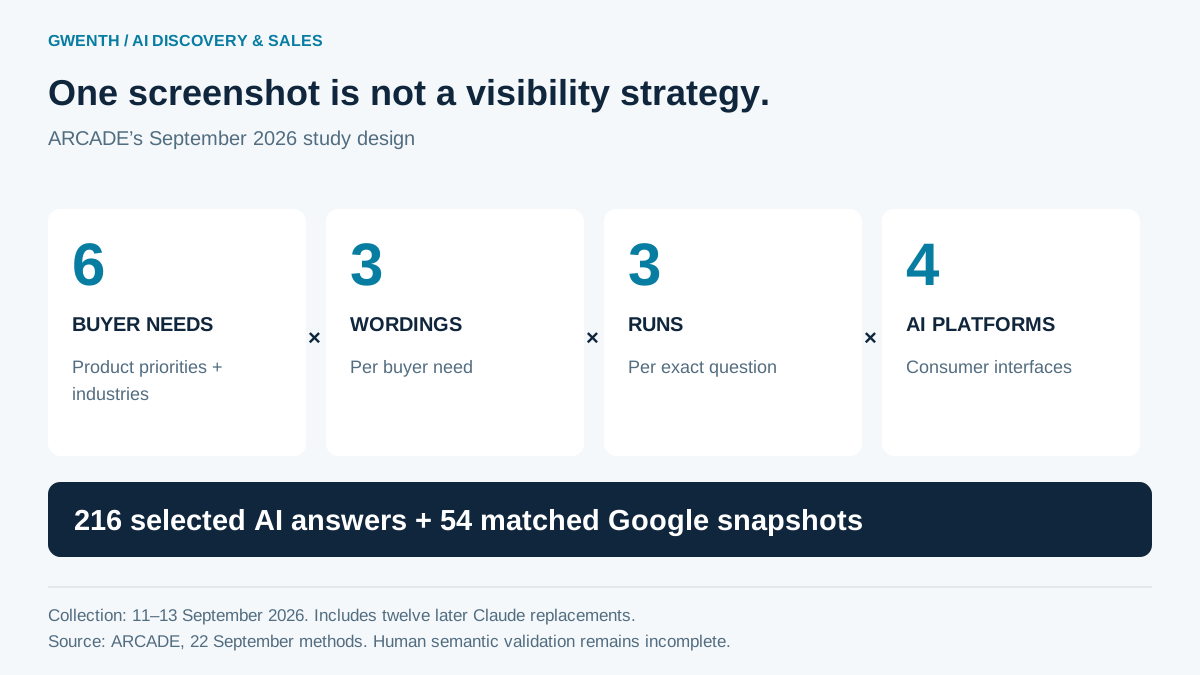
ARCADE’s September 2026 study examined CRM discovery through 18 natural questions: six buyer needs with three intended meaning-equivalent wordings each. Three runs across four consumer AI platforms produced a completed view of 216 selected answers, alongside 54 Google snapshots. The mean recommended-product overlap across exact repeats ranged from 0.584 to 0.781 by platform. That is set similarity, not accuracy or an individual brand’s inclusion probability.
The observations were collected on 11–13 September, with numerical methods updated on 22 September. Twelve Claude answers were later replacements for unsuccessful original outcomes. Human semantic validation remains unfinished. These boundaries matter: the study motivates a measurement design; it does not prove a tactic increases qualified leads.
Choose the buyer decision before the keyword
For a sales product, “best AI software” is too broad to define a useful editorial brief. A more actionable question is whether a founder needs a contact database, a CRM, an email sequencer or a system that coordinates account research and follow-up. The article should resolve that choice even when the reader never requests a demo.
Write a one-sentence brief: “This page helps [buyer] decide [choice] under [constraint], using [evidence].” An illustrative brief might be: “This page helps a founder with an existing CRM evaluate reply-aware follow-up, using a worked approval-and-stop scenario.” The constraint prevents the article from becoming another list of generic benefits.
Separate economic questions from workflow questions. A pricing question needs the billing unit, included allowance, variable costs and assumptions. An integration question needs supported connections and failure behaviour. A trust question needs accurately scoped documentation. Do not substitute an enthusiastic category description for the evidence each question requires.
Build an evidence page, not an adjective page
Use an answer-first introduction, then a concrete explanation of how the workflow works. Include inputs, decision points, outputs, exceptions and ownership. Where information is configuration-dependent, say so beside the claim. A diagram can make a sequence easier to inspect; the same consequential information should remain readable in the article.
For example, replace “intelligent follow-up that drives revenue” with a bounded scenario: a seller approves a draft, a buyer replies, and the seller checks whether the next planned action is paused or rerouted. Identify the expected behaviour as a trial criterion unless you have verified it in the product. Do not turn a proposed workflow into an undocumented feature claim.
Google’s people-first content guidance asks publishers to contribute original value, use clear sourcing and avoid exaggerated claims. Our application is to add a useful decision aid: a comparison rubric, a reproducible calculation, an annotated example or a failure checklist. These are editorial choices, not disclosed ranking factors.
Keep discovery access separate from training permission
Google’s AI-feature documentation says existing SEO foundations remain relevant; special AI markup is not required. OpenAI documents separate controls for search crawling and training crawling. A site owner can allow OAI-SearchBot while disallowing GPTBot.
Have the site owner review robots rules, CDN restrictions, public routes and canonical URLs against the intended access policy. Do not unblock private app pages or change training permissions merely because an article recommends better discovery. The goal is appropriate access to approved public evidence, not indiscriminate access to the business.
Run a bounded first content experiment
Choose one buyer need and a small question set before editing anything. Save baseline answers and their dates. Publish one substantive page or improve one existing page. Keep a dated change log and repeat the same question set later, including a few unchanged questions as a descriptive comparison. Record product launches or other changes that might affect the result.
Do not repeatedly query until your brand appears and report only that answer. Preserve unsuccessful captures separately from valid answers without a recommendation. Compare the distribution of observations, not just the most flattering screenshot. The AI visibility measurement guide gives the labels and denominators.
Define a business follow-through as well: can a suitable visitor understand the offer, identify a relevant workflow and take an appropriate next step? Track qualified conversations separately from AI appearances. An increase in one does not establish an increase in the other.
How Gwenth applies this
Gwenth’s content should explain its role as an AI sales execution platform for founders and lean B2B teams. Available account and signal context, approved outreach work, reply context and CRM handoff are more useful topics than unsupported claims about replacing a sales team. Exact capabilities depend on connected sources and configured workflows.
This research series is educational. It does not claim Gwenth includes a GEO monitoring product, knows an AI platform’s ranking algorithm, or guarantees citations, recommendations or sales. A useful next step is to bring one real sales workflow to a discussion and test the evidence behind the proposed fit.
Questions founders ask
Should we publish many articles at once?
Our recommendation is to start with a coherent group that resolves different decisions. A second article should answer something the first does not. The content planning guide shows how to avoid near-duplicate briefs.
How soon will this improve AI visibility?
This study cannot supply a dependable time-to-result or uplift estimate. Publish useful evidence, establish a baseline and report subsequent observations with dates and limitations.
Editorial disclosure: AI assisted the drafting and graphics. ARCADE figures are a first-party, bounded research extract, not independently human-validated results or customer outcomes.
Tags
References
Source material used for factual context in this article.
- ARCADE: September 2026 CRM discovery findings and methods
ARCADE / Gwenth · Accessed
First-party aggregate extract from the 22 September analysis of 216 selected AI answers and 54 Google snapshots. Model-assisted labels; human semantic validation remains incomplete. This is not independent validation of Gwenth.
- AI features and your website
Google Search Central · Accessed
Official Google-only eligibility and reporting guidance; not a ranking recipe for other AI platforms.
- Creating helpful, reliable, people-first content
Google Search Central · Accessed
Supports original, useful, clearly attributed content and accurate authorship disclosures. It is guidance, not evidence that a particular article format guarantees citation.
- Overview of OpenAI Crawlers
OpenAI · Accessed
Documents the independent purposes of OAI-SearchBot, GPTBot and user-triggered access. Crawl access and model training are not interchangeable with a recommendation.
- GEO: Generative Engine Optimization
Aggarwal et al., KDD 2024 / arXiv · Accessed
Original research introducing a visibility-optimization framework and benchmark with domain-dependent effects. Its experimental results are not a promised uplift in current consumer products.