Reader question
What is the difference between an AI citation, a brand mention and a product recommendation?
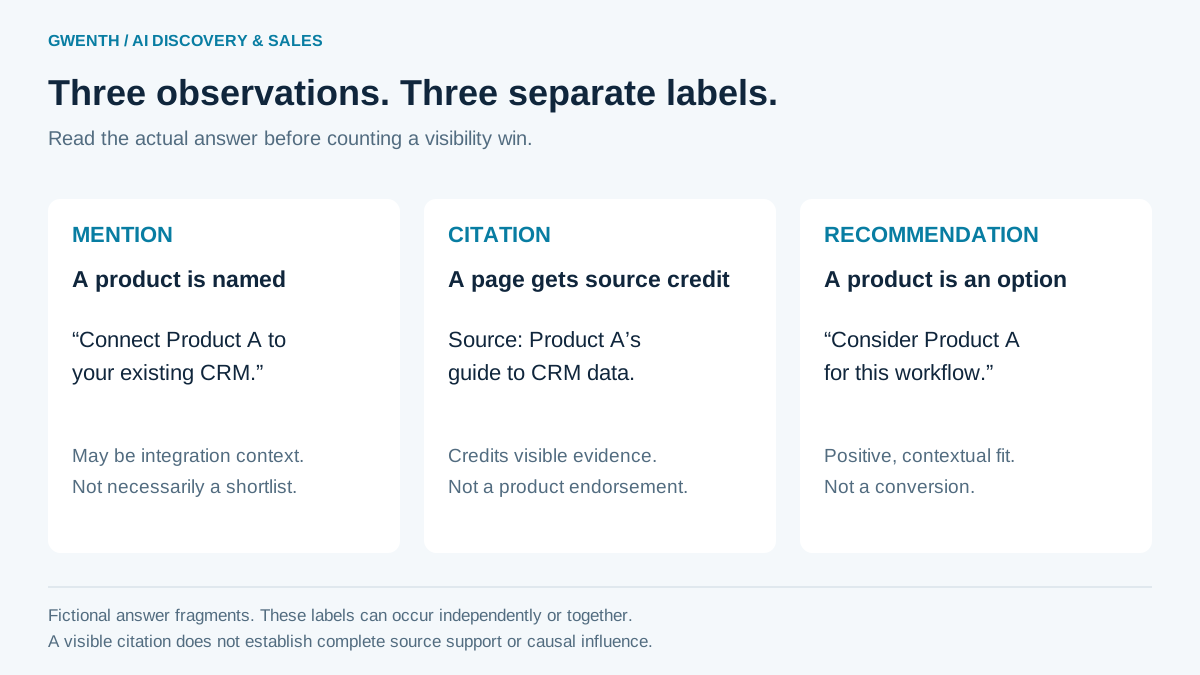
A citation credits a source; a mention names an entity; a recommendation presents an option. They can occur independently, so visibility reporting should preserve the supporting text and never assume one implies the others.
AI Citations vs Brand Recommendations: Count the Right Win
A source link, a brand mention and a product recommendation are different observations. Learn how to label them without inflating AI visibility.
Scroll horizontally to inspect the diagram.
An AI answer links to a vendor’s article. The vendor celebrates a recommendation. But the article might have been cited to explain a category while the answer recommends someone else. The celebration and the evidence are describing different things.
A useful AI visibility report starts by reading what the answer actually says. This is particularly important when the product name appears in a citation badge, a comparison table or an integration example rather than in the shortlist itself.
Short answer
A brand mention names a product. A citation credits a page or domain as a visible source. A recommendation positively presents a product as an option. One answer may contain any combination of these observations. None, on its own, proves a click, a purchase or that the cited page caused the recommendation.
Three fictional fragments, three different records
| Answer fragment | What to record | What not to infer |
|---|---|---|
| “Connect Product A to your existing CRM.” | A product mention in integration context. | That Product A is the recommended CRM. |
| “A CRM stores relationship history.” A source links to Product A’s article. | A visible citation to Product A’s site. | That the answer recommends buying Product A. |
| “Consider Product A for this workflow.” | A positive option in the stated context. | That it is the global winner or independently tested. |
The labels can overlap. The third answer might name the product and cite its documentation. It might also recommend it without a visible citation. Preserve the combination rather than forcing the answer into a single broad “visibility” bucket.
Read the container around a brand name
A table can contain both an existing system and a recommended replacement. The column headings determine which role a product occupies. Likewise, “options worth considering” may provide positive framing for a whole contained list, even when individual rows do not repeat the word “recommend.”
ARCADE’s 21 September evidence corrections include a case in which NetSuite appeared as the existing stack while Salesforce was in the recommended-CRM column. Treating both names as recommendations would have inflated the shortlist. Across the targeted correction release, 21 brand records in 15 selected answers changed. That targeted exercise is not an estimate of the entire dataset’s error rate.
For your own review, save enough surrounding text to recover the role: heading, sentence, relevant table column and any qualification. A keyword match without its container is insufficient evidence for a recommendation label.
Conditional fit is not an overall winner
“Consider Product A when you already use Stack B” can be a positive recommendation for a specific situation. The condition does not automatically make it a neutral mention. Conversely, “Product A integrates with Stack B” may describe a capability without advising anyone to choose it.
Keep an explicit overall-winner label separate. Do not infer preference merely because a product is listed first, appears in the leftmost column or is named in a final summary. This article’s proposed labelling rule is to demand the answer’s own preference language before recording a global winner.
When the evidence is ambiguous, retain an uncertainty note and seek a second reader. An unresolved label is more useful than false precision, especially when a business decision depends on a small difference in presence rates.
A source’s format does not establish independence
Who publishes a page and what the page contains are separate dimensions. A vendor can publish an educational guide, a comparison article or product documentation. A consultancy can publish a review-style list. The article format alone does not establish ownership, editorial independence or commercial neutrality.
ARCADE separates publisher type from content type and retains unknown ownership where evidence conflicts. Its correction ledger reclassified WorkHorse as a CRM vendor rather than treating its comparison-style content as third-party coverage. This changes the ownership interpretation, not the fact that the domain was cited.
Our suggested source ledger therefore records the page URL, operator, apparent commercial relationship, content purpose and evidence date. Before contacting a frequently cited publisher, inspect the actual page and its editorial policy. Citation recurrence is a research lead, not an endorsement of that publisher or proof that coverage can be purchased responsibly.
Why the platform breakdown matters
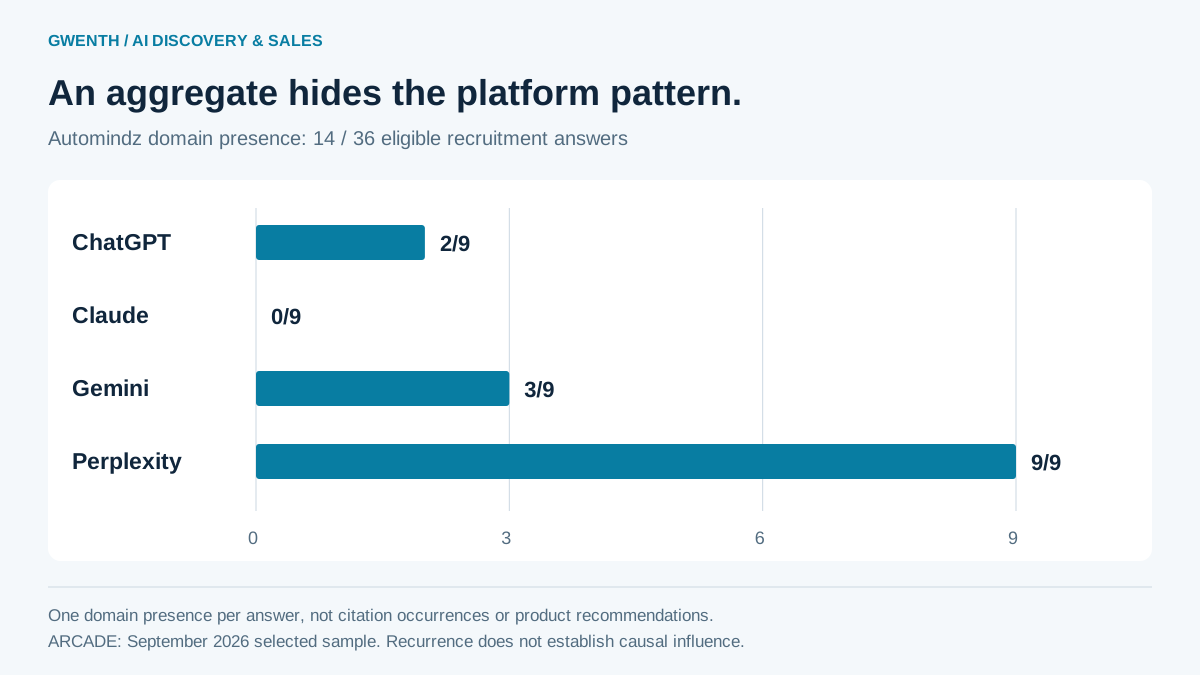
In ARCADE’s recruitment category, Automindz appeared in 14 of 36 answers: two of nine ChatGPT answers, none of nine Claude answers, three of nine Gemini answers and all nine Perplexity answers. That is response-deduplicated domain presence, not 14 product recommendations.
The aggregate 38.9% conceals the platform pattern. It also cannot establish that adding your product to an Automindz page would produce the same result. The study did not run that intervention, and comprehensive source-to-brand support was not established.
The GEO research literature supplies a useful motivation for explicit visibility metrics. Our practical conclusion is narrower: define exactly which observation you want to improve, then evaluate it without using a different observation as a substitute.
Turn classification into better content decisions
For an educational article, a citation can be a relevant outcome even without a product recommendation. Improve it by resolving a real question and keeping the evidence inspectable. For a product-fit page, ask whether a reader can tell who the product is for, what it does, what it does not do and how to evaluate it.
Google’s content guidance emphasises clear sourcing and meaningful original value. Applied here, that means a page should have something worth citing: an explained calculation, a candid workflow boundary, a well-labelled example or useful research. Repeating the company name is not a substitute for that contribution.
Use the buyer-question content matrix to assign different jobs to educational, evaluation and implementation pages. Then use separate dashboards or columns for citation presence and recommendation presence. That keeps an editorial success from being misreported as pipeline.
How Gwenth applies this
Gwenth’s writing should distinguish an observed buying signal from proven purchase intent just as carefully as it distinguishes a citation from a recommendation. A visible event can justify research; a seller must still determine fit and an appropriate next action. That is part of the context-carrying sales execution approach.
The commercial goal is a well-informed prospect who can evaluate a real workflow—not a report full of overstated mentions. Gwenth does not claim that these labels expose an AI system’s internal reasoning or that a source placement ensures recommendation.
Frequently asked questions
Does a citation prove the source supports every claim?
No. A visible link establishes source attribution in the answer. Claim-level support requires examining the relevant source content and its relationship to the statement.
What should we do with uncertain product identities?
Keep the original text and an unresolved label. Do not silently merge distinct editions or treat an integration platform as a CRM product without evidence.
Disclosure: examples are fictional unless explicitly attributed to ARCADE. The study uses model-assisted labels with incomplete human semantic validation. AI assisted this article’s drafting.
Tags
References
Source material used for factual context in this article.
- ARCADE: September 2026 CRM discovery findings and methods
ARCADE / Gwenth · Accessed
First-party aggregate extract from the 22 September analysis of 216 selected AI answers and 54 Google snapshots. Model-assisted labels; human semantic validation remains incomplete. This is not independent validation of Gwenth.
- Creating helpful, reliable, people-first content
Google Search Central · Accessed
Supports original, useful, clearly attributed content and accurate authorship disclosures. It is guidance, not evidence that a particular article format guarantees citation.
- GEO: Generative Engine Optimization
Aggarwal et al., KDD 2024 / arXiv · Accessed
Original research introducing a visibility-optimization framework and benchmark with domain-dependent effects. Its experimental results are not a promised uplift in current consumer products.