Reader question
Does appearing in Google organic results mean a product will be recommended by AI?
Direct organic vendor visibility and AI recommendation visibility are different measurements. Low overlap supports measuring both; it does not establish that SEO is irrelevant or that a particular GEO tactic works.
SEO vs GEO: What CRM Discovery Data Actually Shows
ARCADE found 0.188 mean overlap between AI shortlists and matched Google direct-vendor sets. Here is what that does—and does not—mean.
Scroll horizontally to inspect the diagram.
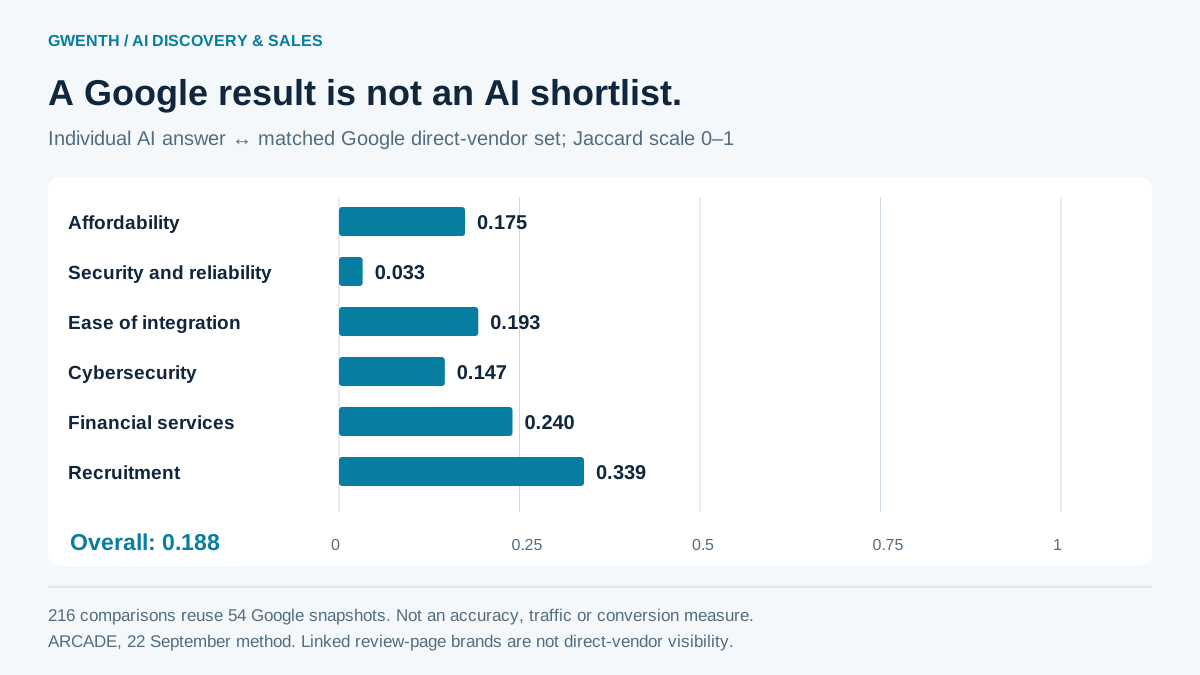
A software company can be visible in a Google result without appearing in an AI-generated product shortlist. The reverse can also occur. Before turning that difference into a marketing strategy, ask exactly what each observation counts.
SEO and GEO discussions become misleading when “Google visibility” means one thing in a chart and a much broader thing in the conclusion. This article explains the narrow comparison in ARCADE and a practical way to use it without declaring that one channel replaces the other.
Short answer
SEO concerns discoverability in search; GEO concerns how a business or its content is represented in generative answers. They can share useful technical and editorial foundations, but their measured outcomes are not interchangeable. In ARCADE, the average overlap between individual AI recommendation sets and matched Google direct-organic vendor sets was 0.188.
First define what counts as Google visibility
Imagine a fictional Google results page containing Product A’s website, a magazine comparison of Products B and C, and an advertisement for Product D. A direct-organic vendor measure can count A. It does not automatically count B and C from the linked article’s body, or D from advertising.
A reader might still discover all four products through that search experience. Consequently, the narrower direct-vendor set is not an exhaustive map of what Google can help someone discover. It is one deliberately defined comparison layer.
The primary ARCADE analysis keeps direct organic vendor results separate from later linked-page evidence, sponsored results and AI Overviews. It compares positively recommended CRM products on the AI side, rather than every brand name appearing anywhere in an answer.
The current results, with their unit attached
| Buyer need | Mean Jaccard overlap | AI–Google comparisons |
|---|---|---|
| Affordability | 0.175 | 36 |
| Security and reliability | 0.033 | 36 |
| Ease of integration | 0.193 | 36 |
| Cybersecurity | 0.147 | 36 |
| Financial services | 0.240 | 36 |
| Recruitment | 0.339 | 36 |
The overall mean is 0.187738, rounded to 0.188. Each of the 216 AI answers is paired with the Google snapshot for the same exact question and repetition. Three matched runs are averaged per question and platform, then three questions per buyer need, with equal weight across four platforms. The same 54 Google snapshots are reused; these are not 216 independent search sessions.
The much lower security/reliability overlap than recruitment overlap shows why a single headline is not enough to describe every buyer situation. It does not tell us which channel is better for either segment. The comparison contains no measured acquisition costs, conversions or buyer preference.
Why an older headline gives a different number
The earlier method combined recommendations from all four AI platforms into one set before comparing that set with Google. Its mean was approximately 0.161. The 22 September method instead measures the individual answer a user might encounter, giving approximately 0.188.
Both calculations use the same selected answers and snapshots. The change is in the question being estimated, not a temporal improvement. The combined-AI result remains a secondary ecosystem-level measure. It should not be silently mixed with the individual-answer headline.
Similarly, later linked-page comparisons retain their separate definition and combined-AI unit. A chart cannot attribute a difference between those numbers solely to including review pages when the unit on the AI side also differs.
What low overlap cannot tell you
It cannot identify the complete information a model retrieved. It cannot show that Google rankings caused, or failed to cause, an AI recommendation. It cannot convert 0.188 overlap into “81.2% of SEO is wasted.” Jaccard divides shared set members by the union of both sets; it is not a share of marketing spend, traffic or recommendations missing from Google.
It also cannot establish that AI has evaluated every eligible product. These are selected answers to a small, purposive set of CRM questions. Twelve Claude answers came from later targeted retries, and the recommendation and vendor-identity labels still lack complete human semantic validation.
A shared foundation does not require a shared score
Google’s guidance says standard SEO practices remain relevant to its AI features and that eligibility does not guarantee indexing or serving. OpenAI’s crawler documentation separately describes search access and training access. These documents support reviewing the relevant discovery controls; they do not publish a universal recommendation algorithm.
Our proposed operating model therefore has one evidence foundation and separate observation reports. Keep approved product facts, useful explanations, linked sources and public access coherent. Then ask distinct questions: which pages receive search visits, which pages are visibly cited, which products are recommended, and which enquiries become suitable sales conversations?
Translate the finding into a small decision
If your product appears in direct organic results but not sampled AI shortlists, inspect the actual buyer questions and answer labels before rewriting the website. Is the page describing a different use case? Is the product only mentioned as an integration? Is the sampled platform using few visible citations? These are investigation prompts, not established causes.
If your article is cited but the product is not recommended, the article may still be serving an educational need. Decide whether its purpose is to explain a category, support a factual claim or help a qualified buyer assess your product. Do not force every educational page into an artificial sales comparison.
If a product is recommended without a visible owned-site citation, record that honestly. Do not claim a specific blog caused the recommendation. The measurement protocol explains how to preserve these distinctions over repeated observations.
How Gwenth applies this
For Gwenth, discovery content should connect a real buyer need to a verifiable workflow. A founder comparing an AI SDR with a CRM needs to understand the role of a sales execution layer, the human decisions that remain, and the limits of the connected context.
Those are useful facts for a reader arriving through either channel. Gwenth should evaluate the resulting conversations separately from the page’s appearances in search or AI answers. This article proposes a measurement distinction, not a new product capability or a guaranteed route to recommendation.
Common questions
Should a lean team stop doing SEO?
ARCADE gives no basis for that decision. It supports keeping AI recommendation observations separate from direct search visibility, while evaluating each channel against your own business evidence.
Does 0.188 mean AI is only 18.8% accurate?
No. It is average overlap between two defined sets. The study is not a test of which CRM a particular buyer should purchase.
Research disclosure: first-party ARCADE findings, 11–13 September collection and 22 September methods. Human semantic validation is unfinished. This article was drafted with AI assistance.
Tags
References
Source material used for factual context in this article.
- ARCADE: September 2026 CRM discovery findings and methods
ARCADE / Gwenth · Accessed
First-party aggregate extract from the 22 September analysis of 216 selected AI answers and 54 Google snapshots. Model-assisted labels; human semantic validation remains incomplete. This is not independent validation of Gwenth.
- AI features and your website
Google Search Central · Accessed
Official Google-only eligibility and reporting guidance; not a ranking recipe for other AI platforms.
- Overview of OpenAI Crawlers
OpenAI · Accessed
Documents the independent purposes of OAI-SearchBot, GPTBot and user-triggered access. Crawl access and model training are not interchangeable with a recommendation.